Post New Topic  Post A Reply
my profile | register | search | faq | forum home
  next oldest topic   next newest topic
»  FireStryker Living History Forum   » History   » Medieval Lifestyles, Activities, and Equipment   » Table Linen

UBBFriend: Email this page to someone!    
Author Topic: Table Linen
Fire Stryker
Admin & Advocatus Diaboli
Member # 2

posted 07-16-2003 09:59 AM     Profile for Fire Stryker   Author's Homepage     Send New Private Message   Edit/Delete Post   Reply With Quote
Firstly, I would like to thank Gwen for introducing the wonderful and often overlooked area of medieval material culture -- table linens. I appreciate the fact that she and J.K. Vernier spent several hours searching for and going through textile documents and pouring over art resources in an attempt to find some nice patterns and discover the actual textile composition (cotton, cotton-linen, or pure linen) and the geographic locations that the wares came from. I am hoping that this will eventually result in H.E. introducing a range of affordable linens at some point in the future. *hint*

Secondly, the research that she started inspired me to look a little more closely at various Flemish/French/Italian art. It’s amazing what little bits of information you miss when you are searching for something else. Also you see the difference in book print quality; faded to crystal clear. But I digress...on to the goodies!

Armed with some of this information and doing some investigation on my own, and being impulsive/impatient – "I want it now" syndrome, culminated in the creation of this table linen.

Historical Images:

Both of these images appear on the covers/dust jackets of "modern" Medieval cookbooks. I don’t have the titles readily available but can post them later. These are the only ones. It seems like every time I look at a van der Weyden or other xv century artists, famous and anonymous, I find a new one.

The first is found on the cover of The Medieval Kitchen. The image is a xv century source.
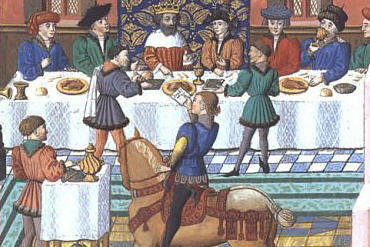
This next one is found on the cover of Maggie Black’s cook book.

http://www.kfki.hu/~arthp/art/l/limbourg/01janvif.jpg

Textile source: Antichi Tessuti Umbri -Tovaglie dalla Collezione Morosini – Spoleto

It is a very nice little book. It contains several color photos and basic information regarding the textile fragments (region, century, description and fabric composition...missing is thread count though on some of the close ups, you can count the threads). The fragment sizes ranged from large to small. They mostly come from the Umbria region of Italy. The samples range from the xv to the xx century.

This example below is from Valnerina-Umbria region. While this textile is an example of xvi century design, the pattern is consistent with late xv century designs which can be seen in the paintings above.
http://www.wolfeargent.com/linens/xvi_Valnerina-Umbria_opt2.jpg

The modern table linen:

Like I said earlier, Gwen inspired me and I had to have one. Also like she indicated in her market research, linen is expensive. Don’t try this unless you have the briquettes to spend!

This is hand woven and made of 100% linen. There are two pieces of equal length and width. 24” w x 72”L (when placed side by side, they make a 48” wide cloth - I want the flexibility based on the size of the board). Thread count is approximately 30/35 per inch. Based on the image above and looking at textile references in the MoL Textiles book (scarce for wool even more so for linen) for thread counts from the 14 and 15th c.

Fabric Progression:

The pattern for getting ready to weave.


courtesy of L. Colpaert

The beginning shows the blue border and the diamonds.
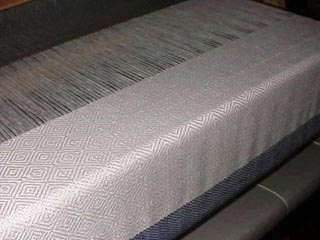

Photo courtesy of L. Colpaert

More fabric…
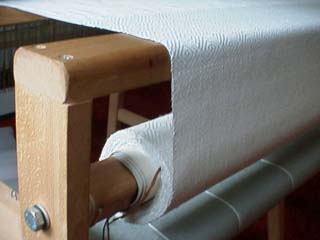

Photo courtesy of L. Colpaert

Final: Composite showing extant fabric and newly woven.
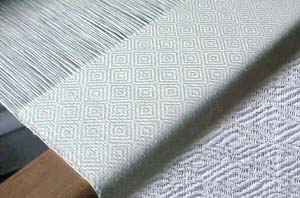

Photo courtesy of L. Colpaert

Enjoy!

Jenn (Thanks Gwen)

--------------------

ad finem fidelis


Registered: May 2000  |  IP: Logged
J.K. Vernier
Member
Member # 123

posted 07-17-2003 08:36 PM     Profile for J.K. Vernier   Author's Homepage     Send New Private Message   Edit/Delete Post   Reply With Quote
This looks like the stuff! The pattern looks exactly right -there are variants in the surviving material, but it looks like you made a good choice.

One of the books we consulted (and I regret not having it at hand) had several towels with plain blue stripe borders. Some of these were badly faded from much use, the sort of thing you wouldn't look at twice in a garage sale bag, and lord knows how they stayed out of the rag-pickers' cart for several centuries, to be picked up by an Italian collector with unusual tastes. But seeing your work all fresh and crisp, they look truly elegant. Please post some more pictures when you set a table with them!

John Vernier


Registered: Feb 2001  |  IP: Logged
Fire Stryker
Admin & Advocatus Diaboli
Member # 2

posted 07-18-2003 07:48 AM     Profile for Fire Stryker   Author's Homepage     Send New Private Message   Edit/Delete Post   Reply With Quote
Hi J.K.,

I wish I could claim credit for the beautiful workmanship, though at some point I would like to learn 'how to', the credit goes to a wonderful Scottish weaver named Liliane Colpaert. She took to it with enthusiasm, even went out and did some research on her own (she's a long time history buff).

We hope to use the linen at our event in September and will definitely take a picture of 'the spread'.

Thanks again to you and Gwen for lighting the fire.

Jenn

--------------------

ad finem fidelis


Registered: May 2000  |  IP: Logged
Gina
Member
Member # 247

posted 07-18-2003 04:26 PM     Profile for Gina   Author's Homepage     Send New Private Message   Edit/Delete Post   Reply With Quote
What a beautiful piece of workmanship!

--------------------

Gina-b Silkwork & Passementerie
Tak v Bowes Departed
Soper Lane


Registered: Nov 2001  |  IP: Logged
Jeff Johnson
Member
Member # 22

posted 07-21-2003 08:53 AM     Profile for Jeff Johnson   Author's Homepage     Send New Private Message   Edit/Delete Post   Reply With Quote
Beauty. Too nice to eat off of. The first wine spill is going to be a heartbreaker.

--------------------

Geoffrey Bourrette
Man At Arms


Registered: May 2000  |  IP: Logged
chef de chambre
Admin & Advocatus Diaboli
Member # 4

posted 07-21-2003 11:12 AM     Profile for chef de chambre   Author's Homepage     Send New Private Message   Edit/Delete Post   Reply With Quote
Jenn pretending to be chef at the moment.

Actually Liliane sent full care instructions including the eventual wine spill.

--------------------

Bob R.


Registered: May 2000  |  IP: Logged
Friedrich
Member
Member # 40

posted 07-21-2003 01:24 PM     Profile for Friedrich   Author's Homepage     Send New Private Message   Edit/Delete Post   Reply With Quote
quote:
Originally posted by Jeff Johnson:
The first wine spill is going to be a heartbreaker.

Scotchguard is period, isn't it?


Hmm... This means that I to prioritize making that table for PPII.

Jenn, let me know how wide a table you want. Taking into account the overlap of the two linen sections and how much edge overhang you would like. And if you want even overhang on each side.


Registered: Jul 2000  |  IP: Logged
Ron M
Member
Member # 39

posted 07-21-2003 08:13 PM     Profile for Ron M   Author's Homepage     Send New Private Message   Edit/Delete Post   Reply With Quote
It'll be nice to see authentic table linens at events, but would the same weaving techniques apply to towels used for bathing?A few illustrations I've seen seem to show small linen towels with the same blue stripe.

--------------------

Ron Moen


Registered: Jul 2000  |  IP: Logged
Fire Stryker
Admin & Advocatus Diaboli
Member # 2

posted 07-22-2003 10:57 AM     Profile for Fire Stryker   Author's Homepage     Send New Private Message   Edit/Delete Post   Reply With Quote
Hi Ron,

I'm not sure, it isn't my area of serious study. Most of the images I've seen with really good detail, show regular 'flat' type weave rather than this diamond pattern.

There's a van der Weyden that shows a towel hanging on the wall that is plain with blue striping toward the edges. I think it's a hand towel as it is near an urn or a wash basin. I can't think of the name and I don't have my "big book of van der Weyden" readily accessible.

Jenn

--------------------

ad finem fidelis


Registered: May 2000  |  IP: Logged
Karen Larsdatter
Member
Member # 382

posted 07-22-2003 01:20 PM     Profile for Karen Larsdatter   Author's Homepage     Send New Private Message   Edit/Delete Post   Reply With Quote
quote:
Originally posted by Fire Stryker:
There's a van der Weyden that shows a towel hanging on the wall that is plain with blue striping toward the edges. I think it's a hand towel as it is near an urn or a wash basin. I can't think of the name and I don't have my "big book of van der Weyden" readily accessible.

Maybe you mean the washbasin and towel from van Eyck's Ghent Altarpiece (1432)?

Or maybe the towel and pitcher from Campin's Mérode Altarpiece (1427)?

Other napkin-sized or towel-sized linens with the same or similar weaving techniques (with brocaded bands on the textiles) do appear in period artwork (as well as extant examples in museum collections, but I'll focus here on the artwork since most of the museum examples are AFAIK not online anywhere at the moment), including:

Towels used for bathing may well have been woven in the diamond-shaped diaper pattern, but seem to generally lack the colored/brocaded stripes along the sides. See Memling's Bathsheba for example; she emerges from her bath, and her maid helps her dry off with a plain white linen towel that seems to have a subtle diaper pattern to it. Towels are not the only textiles associated with bathing, though; the wooden tubs are frequently shown with a lining that is apparently white linen; the board off which the bathers dine has its own cloth; and there is frequently an ornate canopy overhead, even when the bathhouse is indoors. (I've put a small collection of links to such depictions at geocities.com/karen_larsdatter/baths.htm but it's still quite incomplete.)

To add to the piles and piles of illustrations that show tablecloths where the artist has taken special care to make sure that you notice the diamond pattern, there are some illustrations from the Grandes Chroniques de France and The Book of Hours of Marguerite d'Orléans and a 15th century copy of Aristotle's Politics and Economics that just about bash you over the head with the texture, don't they?

[ 07-22-2003: Message edited by: Karen Larsdatter ]


Registered: Nov 2002  |  IP: Logged
Fire Stryker
Admin & Advocatus Diaboli
Member # 2

posted 07-22-2003 02:33 PM     Profile for Fire Stryker   Author's Homepage     Send New Private Message   Edit/Delete Post   Reply With Quote
Possibly. I think it might be the van Eyck I was thinking of.

--------------------

ad finem fidelis


Registered: May 2000  |  IP: Logged
Fire Stryker
Admin & Advocatus Diaboli
Member # 2

posted 07-22-2003 02:46 PM     Profile for Fire Stryker   Author's Homepage     Send New Private Message   Edit/Delete Post   Reply With Quote
Ever checked out the facade on the Palazzo Ducale in Venice?
http://community.webshots.com/photo/6024945/6030778hOILLOuLCu

Pattern look familiar?

--------------------

ad finem fidelis


Registered: May 2000  |  IP: Logged

All times are ET (US)  

Post New Topic  Post A Reply Close Topic    Move Topic    Delete Topic next oldest topic   next newest topic
Hop To:

Contact Us | Wolfe Argent Living History

Copyright © 2000-2009 Wolfe Argent Living History. All Rights reserved under International Copyright Conventions. No part of this website may be reproduced or utilized in any form or by any means, electronic or mechanical, including photocopying, recording, or by any information storage or retrieval system, without permission of the content providers. Individual rights remain with the owners of the posted material.

Powered by Infopop Corporation
Ultimate Bulletin Board 6.01