|
Author
|
Topic: Coinage and currency
|
Gwen
Member
Member # 126
|
 posted 02-25-2002 01:45 PM
    
The type of coins which would have been carried by Red Company soldiers came up as a topic of discussion this weekend.To set the stage, we portray a group of men garrisoned in Maastricht who have been dispatched by Louis de Gruthyuse to assist Edward and Richard rclaim the English throne in 1471. We depart Flushing in March and arrive at the mouth of the Humber 2 weeks later. We have been in England about 7 weeks to this point. Jeff thinks we should be carrying English coinage in our pouches; I think we should be carrying Burgundian coinage. Jeff thinks our banker would have changed the Burgundian money he got from Louis' bank for English coin; I say the guys probably would not be paid while on this short campaign, would have very little opportunity to spend money in England even if they had been paid, and would want to gamble among themselves with coinage they would use back home in Burgundy. Any thoughts? Gwen
Registered: Feb 2001 | IP: Logged
|
|
NEIL G
Member
Member # 187
|
 posted 02-25-2002 02:33 PM
Most likely answer is that you are carrying both English and Burgundian coins...and quite possibly German, French and lord knows what else!Any coin with an intrinsic precious-metal content is going to be spendable anywhere - that's why every decent-size merchant is going to have a coin-balance. There's also evidence for actual shortages of coin in various areas in the middle ages, too, leading to people using foreign coins, tokens, all sorts of stuff, simply because they couldn't get enough of the "official" coinage to conduct their day-to-day business. You can take argument too far, of course, but I'd say a mix of mostly Burgundian coin, some English (pay, change, or proceeds of loot/robbery) and the occasional french or german coin is probably about right for a group like you. Neil (Who currently has Pounds, Euros and Swedish Krona in his wallet.....)
Registered: Jun 2001 | IP: Logged
|
|
chef de chambre
Admin & Advocatus Diaboli
Member # 4
|
posted 02-25-2002 02:55 PM
Hi Gwen,Edward IV & Company were penniless upon landing in Holland (had to pay for passage with his cloak). Any and all money they had after that point was supplied by Louis de Bruge (then governer of Holland), and any pay disbursed to troops would have been from his coffers. Likely, they would be carrying Dutch & Brabant Groats, Stuivers, Briquets and the like. Edward had no English coinage to give, and the trip south was at a fast pace, there would have been little time to arrange any large money matters, and he had no influence to do so until he reached London, and was acclaimed. Hope this helps -------------------- Bob R.
Registered: May 2000 | IP: Logged
|
|
|
|
chef de chambre
Admin & Advocatus Diaboli
Member # 4
|
 posted 02-25-2002 07:31 PM
This is a 1474 Double Briquette that we just added to our collection not too long ago. 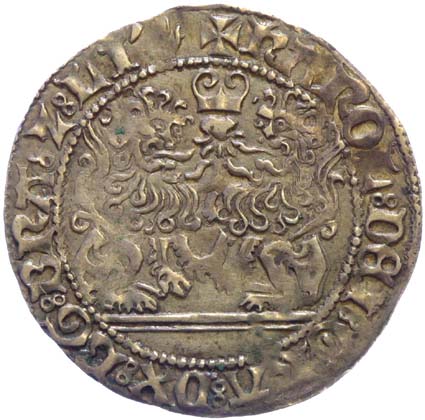 [ 02-25-2002: Message edited by: chef de chambre ] -------------------- Bob R.
Registered: May 2000 | IP: Logged
|
|
|
|
Callum Forbes
Member
Member # 230
|
posted 02-25-2002 09:19 PM
I do late-14th century so can't comment on the original question but I would assume that in the medieval period as a whole that people would have carried mixed coinage if they moved around a bit as there would be an instrinsic value in any coinage regardless of its country of origin?-------------------- URL=http://www.jousting.co.nz Facebook [URL=http://www.facebook.com/profile.php?id=1290562306]
Registered: Oct 2001 | IP: Logged
|
|
NEIL G
Member
Member # 187
|
posted 02-26-2002 03:13 AM
Hi;Callum said
-------------------------------------------- I would assume that in the medieval period as a whole that people would have carried mixed coinage if they moved around a bit as there would be an instrinsic value in any coinage regardless of its country of origin?
------------------------------------------ Three things come to mind. First off, if people are travelling a lot, are they going to be carrying an enormous amount of coin? Money is HEAVY....(even modern money - try to carry a million dollars, you'll see what I mean :-).....and it's a pain in the ass, because you have to worry about it getting stolen etc etc By the end of the period, there's as much chance that wealthy individuals are going to be using letters of credit drawn on one of the Lombard banks as that they're actually carrying bushels of gold around with them. I can't imagine a bunch of soldiers are likely to be doing that, but it's worth bearing in mind. Second, we automatically think of coinage as the way to carry wealth, and that isn't necessarily the only way. There are a lot of medieval comments which suggests that plate and coin are regarded as essentially interchangeable - you can display your wealth with an elaborate buffet of silver dishes, then if you need the cash, it can be easily melted down for bullion. Again, probably not the solution for this case, but worth remembering. Thirdly, using other people's coinage even inside your own country is well-attested even after the medieval period. Think about the English Guinea, worth one pound, one shilling. Where did we get such a stupid unit? Because english privateers flooded the country with captured spanish coin in the sixteenth century, and that was the bullion value of the coins. Neil
Registered: Jun 2001 | IP: Logged
|
|
Fire Stryker
Admin & Advocatus Diaboli
Member # 2
|
posted 02-26-2002 08:41 AM
Hey Gwen,Actually, you might be able to use this coin as it was minted through most of Charles' reign. We just happen to know that this specific one was minted in 1474 from its location. We have a Ghent Mite on the way from the Netherlands as well as a grote and a double stuiver from Bruges that we can send images of when they arrive. ---
I think the Red Co. folks would carry a mixed bag of coin primarily due to the fact that they are coming from Burgundy (a cultural crossroad) and have interactions with people from all over Europe. Being from a middle class aspect, the Captain and his wife may have access to "paper" money, but I think they would still carry some personal coinage. Jenn
Registered: May 2000 | IP: Logged
|
|
Gwen
Member
Member # 126
|
 posted 02-26-2002 11:34 AM
Thanks for the info Jenn!!I'll look forward to seeing pictures of the other coins. We are really anxious to find the proper coinage so we can have some manufactured for the Red Co.'s use. Can you tell me if this briquette would look the same in 1471 (or preferably before), and any changes? Where would they have been minted in 1471 or earlier? If this thread is becoming too boring, feel free to email me privately! Thanks!! Gwen, who has a banker anxious to carry around bags of cash.....  Edit: I forgot to ask the value of these coins. no double Angels for us, thank you very much! Mostly we need the small stuff the guys would be carrying. [ 02-26-2002: Message edited by: Ginevra ]
Registered: Feb 2001 | IP: Logged
|
|
NEIL G
Member
Member # 187
|
posted 02-26-2002 12:09 PM
Hi Gwen;I know you only said it as a throwaway line, but would your banker really be carrying BAGS of cash? I'd have thought that coffers were much more likely, and more practical, as well. Incidentally (other than the banker), how much cash would you expect your troops to be carrying? My feeling is that if I'm a man-at-arms (and therefore being paid 12d a day), I'm probably going to have three or four shillings plus some change on me, while the valet who gets paid 3d a day to tend my horse probably only has about sixpence on him - a lower amount than me, since he can expect me to provide some things for him, perhaps in lieu of wages. The rest of my travelling money is entrusted to my lord for safekeeping, and is in his strongbox back with the baggage.... Neil
Registered: Jun 2001 | IP: Logged
|
|
Gwen
Member
Member # 126
|
posted 02-26-2002 01:17 PM
Hi Neil-Yes it was indeed a throwaway line and not meant to be taken literally. We understand that the soldiers will have a minimum of cash, just enough to pay their laundresses, buy some food and of course gamble. They propably have more in their pouches than they might if there were "campfollowers", but this is not a rich army by any means. Not cold and starving, but not exactly ragged, either. After all, we've had a pretty cushy garrison in Maastricht, and we've only been on the road for 7 weeks. Orlandino does want to have enough cash around (as you say, in coffers and well guarded) to justify his portrayal as the guy who is overseeing the dispersal of cash to the scourers, company paymaster, etc. The story (since there is always good input when you all know the whole picture) is that Orlandino works for the Medici bank, and is Louis de Gruthyuses rep keeping and dispersing Loius' money. Gordon (Orlandino) has researched all of this and I must shamefacedly admit that I am a bit behind on what he knows about how it all fits together....  Please note that we are still researching and working out how this all happens, so please bear with me. Gwen
Registered: Feb 2001 | IP: Logged
|
|
NEIL G
Member
Member # 187
|
posted 02-26-2002 01:36 PM
OK, with that setup, you don't need to have much actual cash at all - what you need to have is the boxes, preferably weighted with sand.After all, Orlandino isn't going to casually throw open those strongboxes and let complete strangers paw through the money, is he? If he's a banker, he's going to act like one, and that means those boxes stay locked unless money is going in or out, and even then, they're opened for as short a time as possible. Incidentally, it's probably worth him working out how much cash he is entrusted with, and how much that weighs - even paper money is surprisingly heavy in large quantities. Also, if it becomes important, a couple of authors say that the normal way of moving coin is by packhorse, rather than wagon - put a half-load on the horse, and then if anything goes wrong the horse can keep up with your mounted men, where a wagon couldn't. Don't have a period source for that off the top of my head, though. Neil
Registered: Jun 2001 | IP: Logged
|
|
haramaki
New Member
Member # 132
|
posted 02-26-2002 01:56 PM
With that kind of intro, how can I resist posting? Hello all! My name is Gordon Haramaki and I'm currently a grad student at UCLA in musicology. I've been following the list for awhile now and enjoying the dialogue. I joined the Red Company about a year ago and my portrayal (Orlandino) pretty quickly morphed into an Italian banking type (though I have to say that I've been carrying a pike around more than I've been carrying around cash). Bob Reed was very generous with his research and suggestions for this personna, but any and all out and out historical blunders that I might write are totally mine. One of my main aims, along with Steve who portrays the Company's clerk, was to have coinage circulating through the camp, believing that the activities brought about by the exchange of money would make it easier for people to inhabit and explore their personnas. But I'm beginning to wonder how much money would actually be around camp... I like the idea of my character showing up for payday, but I equally like the idea that promised salaries would be delayed to keep the soldiers hanging around, especially if they are in foreign territory. Any ideas on how much bartering is going on in military camp? Gordon Haramaki
Registered: Mar 2001 | IP: Logged
|
|
|
|
Adhemar
Member
Member # 274
|
posted 02-28-2002 08:41 AM
quote:
Also, if it becomes important, a couple of authors say that the normal way of moving coin is by packhorse, rather than wagon...
I was just reading Richard Vaugn's John the Fearless, and there was a reference in there to money being packed in barrels and moved about on carts... I'll have to see if I can trace that down, now. Ta Morgan -------------------- Ta Adhemar Imagination was given to man to
compensate him for what he is not;
a sense of humor to console him
for what he is.
Registered: Jan 2002 | IP: Logged
|
|
chef de chambre
Admin & Advocatus Diaboli
Member # 4
|
posted 02-28-2002 09:44 AM
Hi All,I opught perhgaps mention the reference to the 8,000 man draft from Flanders, sent as reenforcement to the Siege of Nancy in the late Autum of 1476 "with fresh livery, and three months pay in their purse's".... -------------------- Bob R.
Registered: May 2000 | IP: Logged
|
|
|
|
Dave Key
Member
Member # 17
|
posted 02-28-2002 12:36 PM
Not sure on how a Burgundian would be paid but the traditional payment for English Soldiers is ...
Quarter at signing of Indenture
Quarter at muster
Half paid monthly whilst on campaignPayment is provided to the Indentured man who distributes to his men There does appear to have been a controlled market within the military camp but whether this was beneficial/detrimental is another matter. However there were certainly disputes as to HOW the soldiers were paid ... i.e. Sterling or French coin whilst in France (or in kind (food) as happened in Calais at least once from what I can remember). It's all rather netly described in the Paston-Gloucester Indenture of 1475 1st Quarter :
"takyng for hym-self xviij d.
a daye and for euery archer vj d. by
the daye, of the whiche wages the sayd Edmond hath reseyued for the first quarter of the sayd hol yere the daye of the sealing of these presentes" 2nd Quarter :
"And for the seconde quartere of the sayd yere the sayd Edmond shalbe payed by the sayd Duc of the wage of hym and of yche
of his sayd retenue at the makyng of the mostres of hym and the same his retenue afore such comissioners as shal be deputed ther by the Kyng
oure souuerayn lord, at wiche tyme shal begynne the terme of the sayd hole yere and nat affore." 2nd half: "And for the othyr half of the sayd yere
the sayd Edmond shalbe payed by the sayd Duc for hym-self and hys said retenue on the yondyr syd on the see, monethly in Englyshe money or in money there rennyng to the valu of Englysshe money, so all-waye that the same wages be payed with-in x days aftyr the end of eueryche of the sayd monethes or ell the sayd Edmond to be quited and discharged ayenst the Kyng and the sayd Duc of eny covenaunt specifeyd in these endenture,"
As to how the money would be carried ... traditionally cash was kept in white leather bags with a red silk draw cord.
These might be kept in coffers etc.
Personally I'd expect the majority of your coinage to be Burgundian but a fair proportion of lower demnominations to be in Sterling ... but that is a gut feel. Also don't forget that some could be quite old ... I'd expect most English coin to be of Henry VI's reign rather than Edward's 1st reign ... even in Edward's army. Certainly these seem more common as survivals today
Cheers
Dave
Registered: May 2000 | IP: Logged
|
|
AnnaRidley
Member
Member # 97
|
posted 03-02-2002 06:32 PM
Gwen,If you are looking to do reproductions a book that I recently came across may be of interested to you. Buck, Ivan. Medieval English Groats. Greenlight Publishing, 2000. ISBN 1-897738-42-0 Greenlight are the folks behind the detector finds books and this book is comparable in production and content. The book covers Edward I to Elizabeth I, and discusses the marks that occured across the range of mints. I got it from Heritage Web for £13.50. http://www.heritageweb.com/system/index.html Greenlight Publishing also sells directly. http://www.treasurehunting.co.uk/books_home_page.html Mitake.
Registered: Dec 2000 | IP: Logged
|
|
Gina
Member
Member # 247
|
posted 04-03-2002 04:06 PM
I watched a programme last night about the Tower of London which stated that it wasn't until Henry VIII that the English coinage began to be debased - but that coinage from other countries was throughout the medieval period was. Perhaps then an argurment for the use of English coinage in Burgandy? I don't know enough about the subject, but this may be something which those of you who do can follow up. Gina -------------------- Gina-b Silkwork & Passementerie
Tak v Bowes Departed
Soper Lane
Registered: Nov 2001 | IP: Logged
|
|
Anne-Marie
Member
Member # 8
|
posted 04-03-2002 07:01 PM
OK, I'm a doofus. I dont understand this stuff.1. what coins would a burgundian have in their pocketses? a "groat"?
a "shilling"?
a "pence"? arent those english? 2. what are they worth? ie a days labor? a loaf of bread? inquiring minds wanna know....
--Anne-Marie, who plans on doing all kinds of commerce this summer and thinks it would rock to state it all in period coinage..  -------------------- "Let Good Come of It"
Registered: May 2000 | IP: Logged
|
|
|
|
chef de chambre
Admin & Advocatus Diaboli
Member # 4
|
posted 04-04-2002 06:15 AM
Hi AM,A Burgundian would have, in rising order.... mite (more of a farthing - 'money noir' Double mite Groat Stuiver/Patard/Briquete - by the era you are representing "doubles" were what was being minted. You wouldn't be likely to have the gold lion/cavalier (minted under Phillip), or the St. Andrew florin minted by Charles No pennies - groats replaced them in circulation, although of more value.
One of Philip & Charles great accomplishments was the 'rationalization' of coinage across their realm, using these standard coins. There was always some variation in silver content between mints, but Burgundian coinage was freely traded as it was one of the least debased coinages - their neighbor France debased coinage as a regular means of increasing the crown revenues whenever a financial crisis occured. The Burgundians had a vastly more stable economy, and it usually took over a generation for a debasement to occur, sometimes just from the act of circulation, as old coins were turned in to mint new ones.
Bruge had it's own mint, and worked on the mite/groat/patard standard, in the era you portray, all in circulation were "doubles". Mites, being the small change, were kept in circulation forever - Charles only made one issue to my knowledge, and Phillips last issue was 1436. -------------------- Bob R.
Registered: May 2000 | IP: Logged
|
|
Anne-Marie
Member
Member # 8
|
posted 04-04-2002 11:15 AM
OK, mites/groats (groschen)/patard. check.now, the question is, what do they buy? I have tons of info on prices for England (thank you C. Dyer and "standards of living in the later middle ages"!) but how does that translate? for example:
a farm laborer would earn 6d or so a week, while a skilled mason or thatcher could earn 32d. shoes cost 4d, boots cost 6d. tallow candles cost 1 1/2d per pound, while beeswax costs 6 1/2d per pound. the board for a lord in Shropshire was 7d a night, while a groom was only 1d. wine could range from 3-4d a gallon to 8-10d. Ale was 1d or so, depending on quality. spices were 1-3 shillings a pound (how many pence is a shilling?)with saffron being 12-15s. so, how does the english system of pounds/shillings/pence equate to Patard/groschen/mites? and how much does a loaf of bread cost for a burgundian? --AM
(who finds it interesting that a pair of handmade custom shoes costs about a days wages for a semiskilled worker, and it works out to be about the same today. cool!) -------------------- "Let Good Come of It"
Registered: May 2000 | IP: Logged
|
|
|



 UBBFriend: Email this page to someone!
 posted 02-25-2002 08:07 PM


