|
Author
|
Topic: Pennons
|
chef de chambre
Admin & Advocatus Diaboli
Member # 4
|
 posted 06-30-2001 10:36 PM
    
Hi All,I have a quick question regarding the physical construction of small pennons. Regarding the body itself, how would it be hemmed? Secondly, assuming a single piece of cloth is the body of the pennon, how to make the sleeve to fit the post, lance, or hoist. I'd prefer to make the sleeve integral to the pennon itself, rather than a seperate item such as on the larger flags. If someone could answer me quickly, I'd be appreciative. I'd like to make a test pennon for my new bannerole post so I can have it attatched to my armet without it looking foolish, and we have a presentation this coming Saturday. -------------------- Bob R.
Registered: May 2000 | IP: Logged
|
|
Anne-Marie
Member
Member # 8
|
 posted 07-01-2001 02:22 AM
quote:
Originally posted by chef de chambre:
Hi All,I have a quick question regarding the physical construction of small pennons. Regarding the body itself, how would it be hemmed? Secondly, assuming a single piece of cloth is the body of the pennon, how to make the sleeve to fit the post, lance, or hoist. I'd prefer to make the sleeve integral to the pennon itself, rather than a seperate item such as on the larger flags. If someone could answer me quickly, I'd be appreciative. I'd like to make a test pennon for my new bannerole post so I can have it attatched to my armet without it looking foolish, and we have a presentation this coming Saturday.
a pencillette or pennon of silk is easily and quickly hemmed with a rolled handkerchief hem (small, sturdy and looks the same from both sides). the pencilettes and pennons I've seen had a sleeve made by simply folding the fat end over a bit and sewing it down. If this is done ON the pole, you can make it VERY snug. hope this helps...I'm sure there's other folk around here with more experience! --AM -------------------- "Let Good Come of It"
Registered: May 2000 | IP: Logged
|
|
|
|
|
|
chef de chambre
Admin & Advocatus Diaboli
Member # 4
|
posted 07-01-2001 07:11 PM
Hi Gwen,I guessed correctly then. A whip-stitch was what I went with. Despite measuring, which gave me 5" by 15" (and allowing an extra quarter inch for hemming), my pennon came out a little on the small side. As it is just something to put there until I make a proper one, I'm adding an aplique St. Andrews cross, and will paint on the chambre and squadron letters, to practise technique, so it doesn't look like a blank handerchief on a post.  Properly, it will have a gilt saint at the host, followed by a gilt St. Andrews, with the chambre and escadre number following, and the blank little bit on the end being taken up with fusil, briquette, and sparks. Properly, it will have a gilt saint at the host, followed by a gilt St. Andrews, with the chambre and escadre number following, and the blank little bit on the end being taken up with fusil, briquette, and sparks. Thanks much for the advice, it really helped. When I go onto the tougher one, I'll holler for advice again. I'll post a picture of my practise pennon when I finish it. -------------------- Bob R.
Registered: May 2000 | IP: Logged
|
|
chef de chambre
Admin & Advocatus Diaboli
Member # 4
|
posted 07-02-2001 07:24 AM
Hi All,I finished the applique St. Andrews cross last night, and now I'm looking to paint the chambre and squadron numbers on. (It looks spiffy BTW). What type of paint ought I use? (keep in mind I have to finish this before Saturday, and I'm not totaly concerned with accuracy at this point - this is a throw-away). I'd love to use egg tempera, but I don't have the pigments , and if I did I wouldn't waste them on this test piece. -------------------- Bob R.
Registered: May 2000 | IP: Logged
|
|
Dave Key
Member
Member # 17
|
posted 07-02-2001 07:31 AM
BobSorry for coming into this a bit late but what characteristics are you looking for? It sounds like you've pretty well finished. If it's of interest (and I can find the diskette) I did write a bit on pennons a few years ago in a reply to a letter from someone in the White Company. This is primarily targeted at English flags but inevitably uses Burgundian evidence which would be relevant to you. Cheers
Dave
Registered: May 2000 | IP: Logged
|
|
Fire Stryker
Admin & Advocatus Diaboli
Member # 2
|
 posted 07-02-2001 09:31 AM
Dave, we would love to see the information as we have a couple of "flag" projects planned. Bob's pennon being the smallest and easiest to achieve. The pennon Bob is working on right now is a practice pennon so you needn't be concerned about coming in on the conversation late.  Cheers -------------------- ad finem fidelis
Registered: May 2000 | IP: Logged
|
|
chef de chambre
Admin & Advocatus Diaboli
Member # 4
|
 posted 07-02-2001 07:29 PM
Hi Dave,It is very much of interest. I'd love to see the information. Cheers! -------------------- Bob R.
Registered: May 2000 | IP: Logged
|
|
chef de chambre
Admin & Advocatus Diaboli
Member # 4
|
posted 07-04-2001 12:15 AM
Hi All,As I don't have a lot of choices about the house to work with, I went with applique technique for the letters marking the chambre and escadre. So far I have made the first 'c' out of scrap wool like I made the St. Andrews cross. I cut a strip, folded it roughly into c shape following the style of lettering seen on Burgundian flags, and snipped to final shape. I sewed the flaps down so it stayed in shape, and then sewed it to the flag. One thing to note, when you cut wool thin, it wants to thread apart. I ended up enbroidering crudely the little extentions to the ends of the letters. The flags extant are mirror imaged, so I followed suit with this little pennoncel Two 'c's make one full letter. 1 down, four more to go. I will post an image when I finish. It is whetting my appitite for the full shebang - I cant wait to do the proper one with the gold leaf and the saint. Should I embroider a little firestryker on the end? This will probably be the default pennon until I make the keeper. -------------------- Bob R.
Registered: May 2000 | IP: Logged
|
|
LHF
Member
Member # 71
|
posted 07-04-2001 12:47 PM
Hey Bob,your pennon project sounds like my studying for the chem. exam this friday morning... what time is it?... good, i still have 43 hours to go; what is sleep anyway! please educate me on the constructions of pennons, since i haven't been able to come across any extant examples down here. what type of materials were used in their construction. what methods were used in decoration; it sounds as if you are using different mediums: paint, embroidery, cut outs. also would the type of material change depending on who is using it? good luck in finishing it Bob. daniel -------------------- Db D'rustynail
Registered: Nov 2000 | IP: Logged
|
|
chef de chambre
Admin & Advocatus Diaboli
Member # 4
|
posted 07-05-2001 12:10 AM
Hi Dan,I finished the pennocel about a half hour ago. It is made of white taffeta silk with red wool applique St. Andrews cross, letters, and Roman numerals. I used these materials as I had them on hand, not neccesarily because they are correct. The pennon is a simplified (and thus historiicaly incorrect) version of the chef de chambres mandated pennon to be worn on top of his 'sallet'. A proper one would be the same colour as the company banner, and have the company Saint next the hoist (in the manner it appeared on the flag), followed by the chambre and squadron designation, followed by a St. Andrews cross (in a variety of styles, some with entwined monograms), and usually a fusil & briquette with sparks. The only remaining fragments of this type of helmet flag are made out of silk, with gold leaf applied. The flag can only be tentatively reconstructed. Pennons, standards and banners could be made in a variety of ways, the simplest being made of linen with whatever decoration adorning it painted on. Cennini in his book mentions a varietly of methods & materials, including aplique, painting, and gold and silver leafing. A flag would of course be made of material appropriate to the importance of said flag. A pennant marking out 20 men would probably be linen, wool, and painted or appliqued. Most of the surviviung Burgundian banners have a linen core, a silk cover, and are painted and gilded, and at one time had a silk fring couterpotent blue & white. Many had apparently been painted in Masters studios in Flanders (accounts exist for payment of the artist and rough descriptions of the flags ordered). Even amongst this splendour, there are smaller linen painted pennons for small subdivisions of units. I took photos, and Jenn will develop and post them tomorrow. (along with pictures of me riding in armour, and hopefully some good photos of Phantom. -------------------- Bob R.
Registered: May 2000 | IP: Logged
|
|
LHF
Member
Member # 71
|
posted 07-05-2001 01:49 AM
hey bob,congrats on its compleation. i like to check out the pics when you post them. we're trying to get ready down here for a small show of arms in september. i've been thinking of constucting some type of pennon for our group. it will be another of the many projects that i'm undertaking. i'll e-mail you later with details. right now i'm trying to gather research on liveries, banners, or colours of the florentine and venetian militia. i haven't found much reference to liveries from florence, 'cept for the red fleur de lis on a white background as a banner. nothing as far as liveries issued to the militia. for venice there is of course the lion of st. mark, golden on red. there was mention of alternating red and white stripes on issued liveries... can't find the reference now though. sleep now, must go... daniel -------------------- Db D'rustynail
Registered: Nov 2000 | IP: Logged
|
|
chef de chambre
Admin & Advocatus Diaboli
Member # 4
|
 posted 07-05-2001 09:25 PM
Hi All,Sorry to say that the photos won't go up until tomorrow. The lab had taken a few days off, and as a result their same day turn-around time is a day later than usual. I will post them tomorrow night. -------------------- Bob R.
Registered: May 2000 | IP: Logged
|
|
Dave Key
Member
Member # 17
|
posted 07-06-2001 11:48 AM
This is the open letter that appeared in The White Company Newsletter in January 1998, hopefully it'll make sense in the context of this thread ... even if it is referring to a letter you haven't seen.
Flags & Pennons
Recently there has been some discussion over military flags of the Wars of the Roses. Initially I had intended to send the following in reply to a letter from Paul Knight, however I felt the content might be of general interest. Please excuse the slightly odd style as parts may relate to Paul's earlier letter, however I hope most will be self explanatory
The majority of the thinking behind the research we have done comes from Colin Campbell's excellent pamphlet "Medieval Flags" published for The Heraldry Society of Scotland. If you want a fresh & challenging insight into this subject there are few better places to start. In adddition I have pulled information from Deuchler's "Die Burgunderbute" (which lists equipment captured from the Burgundians by the Swiss) together with various period sources, like the accounts for Richard III's coronation, the Coventry Leet Book etc. (I can give the references for these if required).
Pennons
Alongside the better known 'Standards' & 'Banners' a group of flags various called 'Pensells', 'Pennons' etc. formed a major part of the c15th military flags. They were small, typically triangular, flags and, as illustrated by the Norwich accounts listed below, they seem to be associated with small unit subdivisions (something which also seems to have been the case in C15th Burgundy).
Although C14th, this Norwich account (taken from the 'View of Arms for the Leet of Conesford' for 27th July 1355) lists ...
"John Mountfort centenar, armed as above with lance & banner" (centenarius, armatus ut supra cum hasta et Baner)
"Thomas de Hornyngg, vintenar, armed with lance and pennon" (vintenarius armatus cum hasta et pyncell)
... the vintenar has 18 men under his command, & there seem to be another 4 vintenars to each centenar ... so the 20's & 100's often assigned to later Medieval English unit formations does appear to hold fairly true (as an aside I am interested in references for these divisions in Edward or Richard's reign). The Coventry Leet Book, where the Captain of the towns troops, preparing for St Albans, has about 100 men & is given a Pennon, although the 'vintenar' & 'centenar' seem to have been replaced by 'Captain'. From most accounts ... & those of Richard III seem to be no exception ... pennons appear to be cheap painted linen flags (although silk was also used cf. Coronation of Richard III & for the Coventry soldiers), in contrast Standards are, typically, far fewer & far better made, e.g. Richard III's Coronation f.63 - 4 standards with bores & "the kynges worde" (a possible ref to a motto on the standard ... if so it is likely to have been painted straight down the body of the flag. The standard double bends used in modern heraldry stems, I feel, from an over-reliance on Tudor, and later, sources.
In contrast numerous contemporary chronicles (e.g. C15th ed. of Froissart & Ed V's Book of Hours) & surving flags (from Ghent & Burgundy) all have the 'down the flag' style. Richard's Standards were sarsynet (a plain silk) embroidered & gilded & cost 40s each. In contrast, the 740 Pensels made at the same time were made from Bokeram (a cheap, possibly sized, linen), had badges added &, significantly, cost only 4d each, i.e. 1/120th of the price of the standards! Also judging by these accounts these Pennons may have been as small as 12"-18"' in length, against the 3 yards of cloth provided for the Standards. Continental references suggest 2 ells (54" if a Flemish ell is used) was more typical & most seem to hover around the 2- 2.5 ells (Flemish ? ... 54"-68"). From memory the White Company Pennon is 54" but I will need to check.
The design of our (first) Pennon is Edward's colours of Blue & Murrey with Badges attributed to Edward on it. I stress Blue rather than Azure as this is what the sources say & azure can be either a different colour/shade (I have one v. early c16th ref to dyeing which details Azure requirng 2x as much woad as Blue) or a heraldic term. In this period I do not believe that Livery is either. By the Tudor period, even Richard III & the College of Arms, maybe it had become formalised, but earlier ... I remain dubious. The Badges are the White Rose en Soleil with streamers (the sun with streamers being referenced at Barnet) and smaller White Roses (which appear regularly throughout Edward's accounts). In addition we added a Unit Identification, this bit is arbitary but draws on direct continental info. & some inferred English, e.g. Soldiers from York wearing badges of the City as well as Richard's & soldiers from Salisbury who had an 'S' embroidered on their Liveries.
So why do Pennons apppear so frequently in records but not Chronicles (including illuminations of them .. although what appear to be pennons are shown alongside Standards in the Salisbury Roll)? Personally I think this is likely to be for precisely the same reason that Chronicles simplify details; ease of comprehension. The Standards & Banners are the primary identifying flags of the main 'Battles' & Individuals. Detailed unit organisation is of little immediate interest/trelevance to the Chronicler.
Flags at Bosworth
I have some serious doubts that the certainty with which many modern writers have described the appearance of the flags at Bosworth. As I mentioned before the bi-coloured edging seen in heraldry is not born out in the surving sources, which suggest that fringes were far more common. However you can not even assume that the Standards themselves were bi-coloured, let alone the fringe, or even what colour they were at all. Richard's accounts for the coronation don't mention buying different coloured silks, just single pieces of sarsynet for the Standards, implying a single colour. Similarly, although reference is made to buying fringe of divers colours (f39-39b), & it is therefore possible that the fringes did alternate in colour, this is by no means certain & may just imply a different a colour on each Standard. The Standard of the City of Ghent has a fringe & this is a single colour ... that of Warwick in the Beauchamp chronicles appears to have a fringe but no attempt is made to show an alternating red/white colouring.
A lot of the problem stems from the tendency to accept the formalisation & stylisation imposed by Heraldry & later sources. For example the association of Murrey & Blue with Richard & Green & White with Henry ignores the fact that Richard was not averse to changing Livery colours & his decor as he saw fit. In the Coronation Richard issued white, crimson, scarlet, blue, purple &, as livery, red gowns etc (f107-108). However be wary here, crimson, red & scarlet were usual colous for Coronations & so may have nothing to do with 'normal' livery. Also f.68 mentions: "v shorte gownes of white and grene clothe of gold for the said henxemen"!
On a different aspect of the use of Standards & Banners at Bosworth. If we accept that in normal situations the Standard was a flag used to identify a body of troops whilst the Banner was to identify a person then Bosworth poses a few problems. Harris, in an article for 'The Ricardian' suggests that Chandon was Henry's Banner bearer, yet the chronicles reference refer to him as the Standard bearer & Edward IV's accounts for the 1475 invasion of France make a clear distinction between the two. Elsewhere, Harris suggests, with I feel a degree of reason, that Henry & Richard were probably both wearing the Royal Arms of England & so would both have had the same Banner (France & England quartered). If this was the case then logically it would not necessarily do Richard any favours, tactically, for the armies to see a royal banner fall ... as it would be unclear whose it was! Whereas it would make a great deal of tactical sense for Richard to drop Henry's Standard. In this partically confused battle with, possibly, both protagonists carrying the same indentifier in very close proximity then the only clear identification from a distance would be the Standard. Despite the fact that there were always several Standards carried it seems likely that one was identifiable as Henry's personal flag.
The assumption that because Chadon, or Richard, or whoever, was mounted means that they carried Guidons (a term used by Harris but I'm not convinced that either the term or the type of flag implied was used in England at the time) rather than Standards simply because they were unwieldly on horseback seems to me to be a spurious arguement. The Beuachamp Chronicles illustrate a Standard being carried on horseback. It probably was impractical to fight with such a Standard ... but Bosworth is the only English battle of the Wars of the Roses that I can think of where a cavalry attack was used. I cannot believe that both Richard & Henry decided to go against all traditions of English military practice at the same time and expect to fight on horseback ... the charge was an exceptional & spontaneous attack ... so why would Richard (or Henry) have specifically made cavalry standards ????
Hopefully a more full & complete analysis will be available later this year, Steve Taylor & I have been mulling the idea over for a while. The above are a few qucik thoughts, any comments would be most welcome.
Dave Key
Registered: May 2000 | IP: Logged
|
|
jcesarelli
Member
Member # 146
|
posted 07-06-2001 12:17 PM
Regarding flags and pennons:The Standard (fr. estendart), a military flag which served as a mustering point and rallying flag for respective retinue during campaigns and tournaments. It is a long flag gradually becoming narrower toward the point, which must be split or swallow-tailed unless it is born by the prince of the blood royal. It contains only crests, badges, mottoes or livery colors and ornaments and not personal arms as with a banner. That which we now call The Royal Standard is actually a banner, though was anciently of the true form. A knight bachelor, upon receiving a promotion in the field, would remove the tails from his pennon, thereby docked, forming essentially the small banner of a banneret signifying his elevation of rank. Size also was proportion relation to rank. Again, these rules may not have been strictly adhered to, here follows the specifications and usage prescribed: * the Emperors Great Standard to be set before the King's pavilion or tent-not to be borne in battle of eleven yards,
* Duke of seven yards,
* Marquess, Earl, Viscount, and Baron of five to six yards,
* Knight baronets of four yards (a guidon)
* a humble Knight bachelor of three feet (a pennon).
*
A Guidon (fr. Guidhomme), is a standard in form but less by a third and ends in a point. Usually carried before a troop of retained men as a rallying point in battle An ancient was the name given to a guidon carried at funerals. A Pennon is a guidon but half the size (averaging between eight and three feet) and charged with crests, heraldic and ornamental devices and mottoes. Of ships this also would be known as a streamer. A Pennant is the same as a pennon but ends forked or swallow tailed. A Pennoncelle, or Pensell, is a diminutive of the Pennon, supposed to be carried at the end of a lance. When used at funerals they are small pointed flags charged with crests and ornaments. A Pavon is a triangular flag of four or five feet long, tapering from about half a yard to a point, the lower side being at a right angle to the staff. A Banderolle is a narrow but long streamer sometimes attached to the staff beneath the flag itself. A vane or wyn also signifies a little flag. Guy Cadogan Rothery, Concise Encyclopedia of Heraldry, Bracken Books 1985
Gale Research, Glossary of Terms Used in Heraldry, Gough & Parker, 1966
GW Eve, Decorative Heraldry, Macmillan,1908
Stephan Friar and John Feruson, Basic Heraldry, W.W. Norton & Co, 1993
Eugene Zieber, Heraldry in America, Haskell House Pub.,1969 -------------------- Joseph It is the very difficult horses that have the most to give you. Lendon Gray
Registered: Mar 2001 | IP: Logged
|
|
Dave Key
Member
Member # 17
|
posted 07-06-2001 12:37 PM
Is this is from a Tudor Manuscript?I know there is one which detials the differing flags, sizes etc. according to degree etc.
The problem is the extant evidence for the mid C15th doesn't really fit. For example the length of the standards does not match those found nor does it match the cloth purchases for Standards in extant records. I'll try and fish out the MSS ref. Cheers
Dave
Registered: May 2000 | IP: Logged
|
|
jcesarelli
Member
Member # 146
|
posted 07-06-2001 12:58 PM
No,To the best of my knowledge, these were the guidelines up through 1400, therefore the "High" Middle Ages. I do not know if the guidelines changed during the Tudor period. -------------------- Joseph It is the very difficult horses that have the most to give you. Lendon Gray
Registered: Mar 2001 | IP: Logged
|
|
Brenna
Member
Member # 96
|
posted 07-06-2001 03:57 PM
I'm looking forward to more references on this thread. I fear what knowledge I have of this type of thing is limited to things more 17th century. I know what an ensign is. I know that Charles I's standard was raised at Oxford and it fell over, which was considered a poor omen. That's about it. Thanks for the insights. Brenna -------------------- Where in this world can man find nobility without pride, friendship without envy, beauty without vanity? Here, where grace is laced with muscle, and strength by gentleness confined. He serves without servility; he has fought without enmity. There is nothing so powerful, nothing less violent; there is nothing so quick, nothing so patient. England's past has been borne on his back. All our history is his industry: we are his heirs, he is our inheritance. Ladies and gentlemen: The Horse! - Robert Duncan's "Tribute to the Horse"
Registered: Dec 2000 | IP: Logged
|
|
chef de chambre
Admin & Advocatus Diaboli
Member # 4
|
posted 07-06-2001 10:12 PM
Hi All,First off, Dave - we recieved the jpeg, and Jenn is tinkering with it as it is a huge file, but we will be glad to host it so everybody can see the striking picture (it looks like the Beauchamp Pagent - is this right Dave) with the unusual standard of the Earl of Warwick. As promised, here are pictures of my pennon project first off, the finished pennoncel (sorry about the rotten camera cropping the picture - it was centered in the viewfinder, but thats what you get for using a disposable camera) 
And here it is on the bannerole post on my armet 

I'll post a closeup of the bannerole post seperately as it is big. Jeff did a wonderful job, and it has a spiffy gilded brass fleur as the fineal. [ 07-06-2001: Message edited by: chef de chambre ] -------------------- Bob R.
Registered: May 2000 | IP: Logged
|
|
Dave Key
Member
Member # 17
|
posted 07-09-2001 07:24 AM
quote:
Originally posted by jcesarelli:
[B]No,To the best of my knowledge, these were the guidelines up through 1400, therefore the "High" Middle Ages. [B]
I know you listed the book refs before but could you see if they reference the actual Manuscripts that they have derived their information from? And I had better re-read my old notes ... Cheers
Dave
Registered: May 2000 | IP: Logged
|
|
chef de chambre
Admin & Advocatus Diaboli
Member # 4
|
posted 07-09-2001 07:43 PM
Hi Dave,Jenn uploaded the GIF file. 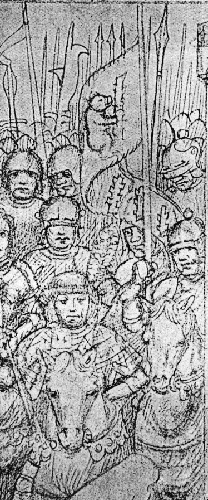 -------------------- Bob R.
Registered: May 2000 | IP: Logged
|
|
Anne-Marie
Member
Member # 8
|
posted 07-10-2001 01:39 AM
ok, am I totally blind? are we supposed to see a little "hat flag" like yours on one of these guys?--AM -------------------- "Let Good Come of It"
Registered: May 2000 | IP: Logged
|
|
chef de chambre
Admin & Advocatus Diaboli
Member # 4
|
posted 07-10-2001 07:24 AM
Hi Am,Nope. You are supposed to see how Warwicks standard differs from the assummed Tudor specifications for Standards, as per Daves posting. I have no doubt that his theory of 'the kyngs wordes' is correct, as every Burgundian flag surviving that has Charles motto runs down the length of the flag. If you want to see pennoncels, look up the "snapshot of the Burgundian army" thread, and you will see plenty in the Master of WA engravings. Also a fair bit can be seen in Louis of Bruges copy of Froissart. I think I can come up with at least a dozen documented sources on the helmet flag - including Charles the Bolds ordinances. -------------------- Bob R.
Registered: May 2000 | IP: Logged
|
|
Dave Key
Member
Member # 17
|
posted 07-11-2001 04:05 AM
OK, I had a bit of a dig last night ... I couldn't find the reference I was really looking for. I think it may be in "English Historical Documents" so I'll have another dig tonight .... that'll teach me for not properly filing things!
Anyway, I had another look in Campbells "Medieval Flags" and found what may be the source of the sizings Joseph's books referred to.
Basically there is a Mss in the National Library of Scotland (Ms. 2515) which is described as a collection of notes on armory. It is written in a C17th hand. Anyway on f.34v - f35 It lists the dimensions of banners and standards. Starting with the Emperors banner which should be 6ft sq down to a Knight Batchelor which should be 2ft sq "for suche was the olde forme"
On Standards it says...
"The greate Standarde must be sette before the kings pauilion or Temte & not to be borne in Battaile. the same must be of the length of xj yards. The kings standard to be borne [presumably therefore in battle] must be of ye lengthe of viij oe ix yards..."
it continues down to 4 yards for knights.This seems too similar for convenience. So that raises the question on how far can we trust a c17th description? What strikes me about this is the use of Emperor (by Campbell's ref. this applies to the Banner but not the Standard). As the Ms later details putting the Cross of Saint George on the hoist of the flag it suggests this is an English Mss. If so, why Emperor? A comparable(?) instance is th Book of St Albans and its description of the falconry birds for each degree of person ... this includes the Eagle for an Emperor, but as is argued well in "The Hound and the Hawk" this list may be purely symbolic rather than a literal association. The same may be true here. Writing in 1916 Lord Lyon Balfour Paul thought the rigid standardisation of sizes based on rank unlikely to have been used in practice and Campbell says "the medieval tracts known to me make no specifications as to length in connection with rank" From what I've seen of accounts etc. I'd agree with this.
What has always concerned me with this whole area is the over standardisation applied by Heraldry in a retrospective manner. If you assume the rigid application of the heraldic rules as generally documented today then Henry VII would not have had the Standards the Great Chronicle of London describes him coming to the gates of ondon with in 1485. Nor would Richard have had the flags he had at his Coronation, the Salisbury Roll must be incorrect and Sir John Howard would certainly never have made his standard out of Worsted!
Additionally it's worth noting that in looking at the references I could find last night there are marked differences between England, France, Burgundy and Germany. A lot of similarities but as many subtle differences. As a post script, I did find earlier (and a c15th illustration) of the tail being cut off a 'standard' to make a banner. The hoist (banner part) bears the arms ... the fly is not visible. This is however different to the known standards which bear either religious images or national/personal badges rather than the personal arms. Cheers
Dave
Registered: May 2000 | IP: Logged
|
|
|



 UBBFriend: Email this page to someone!
 posted 07-01-2001 12:32 PM


