|
Author
|
Topic: Riding styles
|
|
|
Fire Stryker
Admin & Advocatus Diaboli
Member # 2
|
 posted 09-29-2004 08:21 AM
    
Hi Macha,I think that Jeffrey Hedgecock is probably the only person I know of who has as close to an authentic medieval saddle as you can get. It is a saddle of war and not a general purpose riding saddle. From what I've seen, most of the folks, in the US, tend to have a modified modern saddle with a drape of some kind to hide it from view, a Portuguesa/Spanish Bullfighting saddle, or a modern saddle that has been made to look "medieval-esque". I personally don't know of anyone that has Andalusians in the US crowd, at least not in LH circles. My husband and I have draft-x's as do a few others. Though the picture links aren't working in some cases, there's a posting (old) called "Show off your destriers. The link is seriously out of date as my horses are now 6 years old and some of the pictures were taken when they were 2. I know some people who have had bits crafted based on extant bits, but can't say that anyone is using an actual one. "On the bit": My mare has a natural head carriage that at least puts her forelock and nose on the vertical without too much effort on my part and impulsion from the hindquarters has never been a problem. Jenn [ 09-29-2004: Message edited by: Fire Stryker ]
Registered: May 2000 | IP: Logged
|
|
Macha
Member
Member # 667
|
posted 09-29-2004 12:26 PM
Hello Jenn, thanks for the reply. Had a look at the "destriers" pictured and can see a strong preference for drafty types. I wonder has anyone ever tried - or heard of - an Irish cob? It's a uniquely Irish breed of small (14hh - 16hh: average 15hh), active, ride/drive light draft which is extremely docile, trainable and capable of carrying a heavy (ie. armoured) rider. Also has a delightful character and is extremely people-orientated. We use them here a lot as adult-beginner rides in riding schools. Also make superb jousting destriers, incidently. Our company uses the small, lighter Friesians and Spanish/Andalusians too. We make and use authentic bits, bridles and saddles from 12th - late 17th century designs, and train our horses to go in different styles from 12th - 17th century.My question re "on the bit" is because almost all contemporary illustrations show horses in this posture, even overbent (by modern standards), and the literature - such as it is - stresses the importance of riding in collection and control. Draft horses seem to benefit from the added balance afforded by gathering the frame together and getting the hindlegs to where they can be best used (result of proper collection). Just in case you're wondering, I'm not a dressage freak, but I do a lot of High School training (Spanish walk, levades, passage, lancade, tèrre-à-tèrre, etc.)with our exhibition horses and find they cannot get the balance until they have learned how to gather their bodies; collect in other words. I'd value everyone else's input here - I'm the only High School trainer in Ireland, and it gets a bit lonely in the land of "bash and kick". All the very best, Macha
Registered: Sep 2004 | IP: Logged
|
|
Angelique
Member
Member # 404
|
posted 09-29-2004 06:32 PM
Hello Macha,Hmm, bona fide dressage queen here with some Living History interest thrown in. (I started out in American Civil War, now lean towards English Civil War, etc.) Otherwise I show (primarily for others as my personal horse was not purchased with the kind of budget my clients have) ALOT. I have been lucky enough to ride Friesians, Andalusians and a variety of other horses in dressage. I have found that while the "baroque" horses do not generally have the extravagant warm blood style gaits, they tend to collect more naturally. As one of the European trainers I had a clinic with puts it: "They are born with their nose in the bucket." A horse with a shorter back and a naturally arched head carriage will collect much more easily and will carry himself in what the modern eye thinks of as a "frame." I have often wondered whether the "on the bit" look of some illuminations/illustrations was artistic license or a reflection of riding fact. (Of course, this automatically discounts any woodcuts, etc. from ANYONE such as Dom Duarte, Pluvinel, Guerniere, the Duke of Newcastle, etc. because we KNOW those horses are supposed to be on the bit!) No, I don't do high school, well-trained generous schoolmasters who let me do the cool stuff is about my limit  [ 09-29-2004: Message edited by: Angelique ] -------------------- Dahlin', this can't be real emergency, I only brought one bottle of bourbon and one bottle of Tabasco...
Registered: Dec 2002 | IP: Logged
|
|
Callum Forbes
Member
Member # 230
|
posted 09-29-2004 08:38 PM
Jeff and Rod Walker would be the only two jousters that I know of who have correct replica medieval saddles. Although I know that some of the equestrian reeanctors in the UK also use them. Jeff's is described above but Rod also has a replica saddle based on the Henry V saddle. I have ridden in it a couple of times when I've been over in Australia and once you have gotten used to it, it is very practical for the kind of activities that we do.I was planning to get one made locally myself but after taking the $ into account and after seeing some Portugese saddles while in Sweden recently, I have decided to buy one of these instead. While they are not period replicas they are the next best alternative in my opinion. We don't have many Andalusians in New Zealand but I do like the sound of the Irish Cob. Sounds familar to the Welsh Cob whcih we do have in some numbers here and if they were slightly bigger would be my first choice of horse for jousting. Unfortunately the Welsh Cobs here rarely break 15 hands. They are often crossed with thoroughbreds to bring them closer to 16 hands. Baroque riding is also not present here although also while in Sweden I saw one of the Swedish riders do some very nice Baroque exercises during several of the displays I saw there and I will be definately looking at doing some training this style if/when it ever arrives down here. [ 09-29-2004: Message edited by: Callum Forbes ] -------------------- URL=http://www.jousting.co.nz Facebook [URL=http://www.facebook.com/profile.php?id=1290562306]
Registered: Oct 2001 | IP: Logged
|
|
Mike
Member
Member # 596
|
posted 09-30-2004 09:17 AM
Hi Macha,I agree with you regarding Irish cob, I am a proud owner of one who I am currently "conditioning" i.e getting him used to shiny things and anything else that may spook him. They have a very affable nature, gentle and responsive. They certainly are chunky enough to bare the weight of an armoured rider, and fit what is accepted by some to be the optimum height, i.e 15hh ish. With regards to riding "on the bit" nearly all horses portrayed in medieval illustrations are, in my opinion, over-bitted, and therefore behind the bit and resisting it. This goes for "civillian" and military uses. When you look at extant examples from the period this is not too difficult to imagine! I agree totally with your opinion on the importance of collection; after all horses are "rear-wheel drive" so to speak, and bringing the quarters into use effectively would make them a lot more stable and provide a much more effective "punch" in a joust / strike. I'd be really interested to see evidence of high school / classical riding being introduced / re-introduced pre 17thC. Although illustrations show something that is akin to a classical seat, many other facets point to the style not being completely used. I think that the illustrations tend to be indicative of fact and are reasonably accurate. They illustrate severely-bitted horses that are more often than not collected, not over-tracking and the rider's contact at times could best be described as "loose". Sorry for the rambling opinion, but this is more than just a pet interest for me! Mike PS - Some of the best x-country experiences I've had have been in the Emerald Isle 
Registered: Apr 2004 | IP: Logged
|
|
|
|
|
|
|
|
Fire Stryker
Admin & Advocatus Diaboli
Member # 2
|
posted 09-30-2004 11:09 AM
Like many of the boons of the Renaissance, a lot of it started in Italy and spread to Northern Europe. For example Two of Pignatelli's* students, Salomon de la Broue and Antoine de Pluvinel, returned to France and started the tradition there.You are correct, according to their own history, the first record of the Spanish School dates to 1572. I think it is debated as to whether it developed in parallel or was an offshoot of the Neopolitan School. There is also Markham Gervase (1607). I believe he was trying to translate Grisone's work before deciding to write his own. You'd have to do some digging to see when he started the translation. You might barely come in under the wire for 16th century in England. For 15th Century England, I doubt you'll find evidence for any high school maneuvers. I've been researching for a while and haven't come up with anything "solid" for the Continent. Though Pietro Monte may provide some usuful insight into this area. But even if proof exists, you run into the caveat from a presentation standpoint, "was it done in my geographical location?". *Pignatelli was a student of Grisone. He left no known works.
Registered: May 2000 | IP: Logged
|
|
|
|
Macha
Member
Member # 667
|
posted 09-30-2004 12:01 PM
Hmmmm, interesting that you think medieval horses were "overbitted". Anyone ever do any riding in Spain? Every educated horse ridden "Doma Vaquera" style there (as opposed to "Doma Classica", which is modern competition dressage style) goes in a fairly impressive curb bit, and the vast majority go very happily, I must say. Much lighter, more balanced and responsive than the poor snaffle-tortured creatures we see over this direction. I believe that Spain and Portugal are the last repositories of the old "educated" riding style, older certainly than the Spanish Riding School of Vienna (ever wonder why it is called "Spanish" riding?), and thus older than Pluvinal, de la Guerinierre et al. Incidentally, we train all of ours to ultimately go in curb bits and have never had one go behind the bit, above the bit, or show the slightest resistance even when using the extremely long shanks and high ports of the later 17th century. Of course it takes a number of years to get to the highest stages, and we don't let inexperienced people near the High School bits (everything also goes in straight-bar snaffles too, by the way). But then, as I was told in Portugal, it ain't the bit, its the rider. If I can ever figure out how to work the "add a picture" thingy I'll post a few pics of our horses working in their "official" gear and you can judge for yourselves if they look happy (and collected) or not.
Registered: Sep 2004 | IP: Logged
|
|
Fire Stryker
Admin & Advocatus Diaboli
Member # 2
|
posted 09-30-2004 12:59 PM
Off Topic:Pictures (must be on a web server):
1. Copy the URL to your picture
2. Go to Fire Stryker
3. Click Reply to Topic
4. Click the "Image" button under Instant UBB Code.
5. Paste the URL in the window that pops open
6. Click okay.
7. Click the reply or at setp 4 simply type:
[ img ]h t t p : // yourURL dot com [ /img ] *spaces are here to prevent the code from activating. Jenn [ 09-30-2004: Message edited by: Fire Stryker ]
Registered: May 2000 | IP: Logged
|
|
|
|
Dave Key
Member
Member # 17
|
posted 09-30-2004 06:07 PM
Mike,I've also always been interested to see just exactly when, or if, the 'Classical' style reached England.
It is a subject that, as the owner of a Welsh Cob 15.1hh and someone who prefers the Classical style to 'Pony Club' style, I'd love to know more about. I'm also curious what style the Destrier guys or Jeff use and what the basis they use for it is. One thing that made me wonder about this was reading a short article on the saddle of Henry V which includes (if I recall correctly) a more advanced construction than contemporary ... and even later, continental styles. Different technology is often an indicator of different approaches to a problem ... I don't ride well enough, or know enough on the subject to say what was done ... but I'd love to hear peoples opinions. I'd expect to see more 'advanced' techniques more widely spread on the Continent where the mounted warrior always had more prominence than England. Cheers
Dave
Registered: May 2000 | IP: Logged
|
|
Angelique
Member
Member # 404
|
posted 09-30-2004 06:33 PM
quote:
I believe that Spain and Portugal are the last repositories of the old "educated" riding style, older certainly than the Spanish Riding School of Vienna (ever wonder why it is called "Spanish" riding?),
Per the Spanish Riding School:
The Viennese Riding School takes its name from a horse race, which originated from Spain and was well known already in Roman times... "Caesar's brilliant white horse, which Spain sent him". It is after those horses, which (since 1580) were named Lipizzaners in honour of the "Marstall und Stuttery Lipizza" a stud farm near Triest. I looked at the German language version of the site, and I believe the translation to English of "horse race" does in fact really mean "horse breed" but my German is very old and rusty. Another interesting point brought up by the school is this:
Federigo Grisone of Neapels translated and worked on all these notes and wrote a book in 1522 "Ordini di cavalcare" (Textbook of Riding), which became a best-seller throughout Europe. Grisone taught a brutal method of dressage which filled every animal friend with horror. It was the "Ridingbooks" of Antoine de Pluvinel (1623) and Francois de la Guerniere (1730) which first refined the riding style and made the art of dressage more "humane". Macha said: quote:
Anyone ever do any riding in Spain? Every educated horse ridden "Doma Vaquera" style there (as opposed to "Doma Classica", which is modern competition dressage style) goes in a fairly impressive curb bit, and the vast majority go very happily, I must say. Much lighter, more balanced and responsive than the poor snaffle-tortured creatures we see over this direction.
I have to agree with you, the cruelty of a bit rests solely in the hands of a rider. While I have never ridden in Spain, I have seen the cathedral port spade bits used by Mexican charros. They are light of hand and their horses are light in response. [ 09-30-2004: Message edited by: Angelique ] -------------------- Dahlin', this can't be real emergency, I only brought one bottle of bourbon and one bottle of Tabasco...
Registered: Dec 2002 | IP: Logged
|
|
chef de chambre
Admin & Advocatus Diaboli
Member # 4
|
posted 09-30-2004 08:46 PM
It's Fire Stryker. Sorry, too lazy to change from Bob's login to mine. quote:
Another interesting point brought up by the school is this:
Federigo Grisone of Neapels translated and worked on all these notes and wrote a book in 1522 "Ordini di cavalcare" (Textbook of Riding),...
Angelique, just curious, to which book are they referring that Grisone translated and worked all these notes, or is that just a translation program turn of phrase? The copy I have is from 1555, though there were several editions published and thought that one had been published as early as 1522. Yes, he was mentioned as being brutal. His student Pignatelli was said to have been more humane, Pluvinel was one of his students.
Registered: May 2000 | IP: Logged
|
|
|
|
Angelique
Member
Member # 404
|
posted 09-30-2004 10:13 PM
Ah, my apologies, let me include the full contest of that. They are in fact referring to Xenophon's writings.
quote:
Textbook of Riding - a best-seller
1572 - the time of the late Renaissance, in which the "rebirth of the ancient classic form of living" brought a re-evalutation of all values in the whole of Europe. Simple gothic culture with its humane spiritualization and universal God at the centre was at an end. The important and the lesser important gentlemen of the 16th century set about discovering their near and not so near environs, to conquer, to procure absolute power and to demonstrate "ad oculos". Power in politics, power in court, power on the backs of noble horses. In the search for worthy models for their style of life they leafed through old chronicles and found a time, dating back almost two thousand years, found Emperors of ancient Rome, Caesars, Patricians, the "Cavaliers" of classic antiquity. Learned humanists discovered sayings of Socrates, of Simon of Athens, of Plinius about a noble and ancient horsemanship, which was so very different to the awkward, peasantlike tournaments of the medieval times. They found a book "About horsemanship" written by none less than Xenophon himself (430 - 354 BC): " on such horses gods are even portrayed. Men who understand the art of horsemanship, in truth look magnificent " Federigo Grisone of Neapels translated and worked on all these notes and wrote a book in 1522 "Ordini di cavalcare" (Textbook of Riding), which became a best-seller throughout Europe. Grisone taught a brutal method of dressage which filled every animal friend with horror. It was the "Ridingbooks" of Antoine de Pluvinel (1623) and Francois de la Guerniere (1730) which first refined the riding style and made the art of dressage more "humane".
Here is the link: Spainish Riding School - English version Really neat site...and I am so sorry for what I think is a thread hijacking -------------------- Dahlin', this can't be real emergency, I only brought one bottle of bourbon and one bottle of Tabasco...
Registered: Dec 2002 | IP: Logged
|
|
|
|
Dave Key
Member
Member # 17
|
posted 10-01-2004 04:58 PM
What makes me curious is that until a few years ago everyone thought C15th combat was exclusively hack & bash. However far you feel the Talhoffer et al techniques penetrated medieval military society, or were merely a codification of existing techniques refined with a few trick to 'sell them better', the fact is that suddenly the realisation has dawned that what had previously been considered a C16th 'Renaissance' development was already well underway and understood by the C15th, and indeed earlier.It is also accepted that C15th soldiers were reading Classical texts on the structure and use of armies (however much they applied these principles the names given to his unit divisions by Edward I in the C13th shows this). Why then did they not consider the the equestrian texts in a society based upon a mounted elite.
I have little to back thisup in terms of anything other than a gut feel that no-one has looked.
As you say ... noone thought they had veterinary manuals ... but they did. So keep your eyes open. Cheers
Dave
Registered: May 2000 | IP: Logged
|
|
Macha
Member
Member # 667
|
posted 10-02-2004 06:10 AM
Well, if you take it as a given that the educated style of the 16th century did not just spring into existance fully formed, then there must have been a basis from which the principles came. Therefore it is fair to assume that styles of riding in the previous centuries were at least evolving towards the styles expressed in the later ages.Experience has shown us that you cannot just slap on a big curb bit and start hauling away - the horse must be carefully trained to accept and understand what he is being asked to do (ergo the rider must also be educated), or else you get frightened, resentful horses which run away, throw their heads about, go above or behind the bit and in general don't behave as a horse has to behave in order to run down the list. So it would seem to follow, from the evidence of the extant bits excavated and the contemprary illustrations from the Bayeux tapestry onwards (which all portray horses firmly on the bit and in curb bridles)that there was a system of horse training in place which produced horses and riders which looked like the images we see in the manuscripts. Since this is the "look" we are all (I presume?) attempting to achieve, then using the same type of horses, equipment and methods as those we are trying to emulate would seem to be the way forward? The fact that there is a paucity of written evidence for the training methods is a difficulty, but we have a very good verifyer available to us: the horses themselves. When we do all of the above, and the horses look and perform like the medieval horse, then I think we must be doing it right. Yes? No?
Registered: Sep 2004 | IP: Logged
|
|
Fire Stryker
Admin & Advocatus Diaboli
Member # 2
|
posted 11-10-2004 01:15 PM
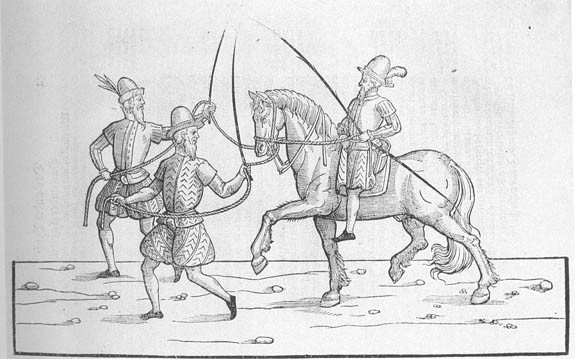
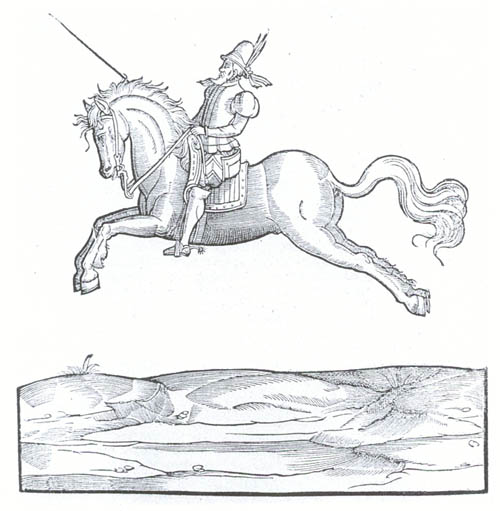
Now I know why those particular woodcuts don't appear in mine, it is because they are not from the Italian, but rather the 1570s German Translation of Grisone's document. It only took me three tries. So I now have the 1550s Italian, a 1570s German facsimile, and a 1610 French translation.As to the last question posed, I don't think anyone is saying that the riding art sprang into existence, indeed we do have Duarte's Book of Good Riding. So there is some discussion in the early 15th century on the topic, though, until someone actually translates it into English, we only have the little bits that people have chosen to give us as to what is really contained therein as far as horse training. I think Duarte was defintely addressing the rider and how to be a better one. I think it is a gross assumption put forward by many modern scholars who do not have equestrian experience, that the Medieval and Renaissance riders were hamfisted thugs that didn't have a clue, purely based on the extant bits and the "cruel" looking spurs. Actually, I think they had a great deal of finesse for just the reason you cited, "you cannot just slap on a big curb bit and start hauling away". If I can ever find that reference to the Italian nobleman, I will post it. It's an amusing little story on "looks can be deceiving and deadly". I think the caution is, that while we can probably utilize classical dressage techniques to make us better riders and have well educated horses, we just can't say "Yes, emphatically, they did this type of training". I think though, I for one am not adverse to teaching my horse the basics of the art.
Registered: May 2000 | IP: Logged
|
|
Angelique
Member
Member # 404
|
posted 11-12-2004 03:46 PM
Well, darn you all, you made me buy books...I now have Pluvinel's book, Markham's book and because I like him and he IS in my ECW period, the Duke of Newcastle's book. All I can say is WOW! The details on the footfall patterns, the use of the "false rein"...OMG, these guys were into my sport way before I had any idea that it began. And as for the woodcuts, ooo la la! As for my S.O's response when the credit card bills arrived...well, we won't go into that... -------------------- Dahlin', this can't be real emergency, I only brought one bottle of bourbon and one bottle of Tabasco...
Registered: Dec 2002 | IP: Logged
|
|
Gordon
Member
Member # 597
|
posted 11-12-2004 06:38 PM
Great stuff being posted here, I've enjoyed following this thread. I also had to go out and buy a copy of Pluvinal, which has proved to be most interesting, and I'll have to track down Markham and Newcastle as well.Right now I'm in the process of training my new horse to the curb. I'm using a Pelham, and presently only using the bridoon rein just to get him used to the idea before moving on to adding the curb rein. Am I far off base with this notion? My other horses had, thank goodness, come already trained to the curb so I didn't have to "figure it out" as it were. Per sharp spurs, the funny thing is that rowel spurs tend to be, on average, less "prickly" than the prick spurs (how odd! Imagine that!) I can run my rowels across my face with no discomfort at all, so I figure that it ought not disaccomodate the horse much if I can do that! In the first post it was asked as to whether anyone rides authentic saddles: well, of late I've been riding a Portuguese saddle (a Portuguese one, not Indian) and I have become rather fond of it. It's not quite as deep as my old Buckaroo saddle (it's a 1910 or so, with seriously high pommel and cantle, but doesn't fit this horse all that well), nor does one gain the contact of the flat saddle, but it's pretty serviceable. Anyway, just to throw that out there that indeed, some crazy folks actually do ride in semi-period saddles, at least. Thanks, and Cheers! Gordon [ 11-12-2004: Message edited by: Gordon ] -------------------- "After God, we owe our victory to our Horses"
Registered: Apr 2004 | IP: Logged
|
|
|



 UBBFriend: Email this page to someone!