|
Author
|
Topic: Plant Lore...
|
Fire Stryker
Admin & Advocatus Diaboli
Member # 2
|
 posted 06-03-2002 12:38 PM
    
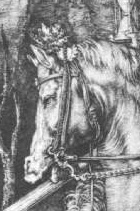
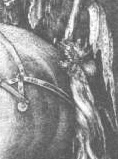
Hi All, I will preface this by saying, I have not studied plant lore at all. I know that some folks have studied herbs and the like. I was recently looking at one of Durer's works, "The Knight, Death, and the Devil" (1519). I have always found the cluster of leaves at the horse's poll and the dock of his tail something of a curiosity. Are the leaves a symbol of affiliation? (Like the white and red roses of York and Lancaster.) Are the leaves a talisman warding of evil spirits or ill humors? I am looking at it from a presentation layering aspect. It might be a nice touch to have a symbolic plant in ones hat or twined prominently in a horse's mane or tail. Might make a great conversation starter at an event with the public. "Hey Mister, how come your horse has leaves on its butt?"  Thoughts... additions? Jenn [ 06-03-2002: Message edited by: Fire Stryker ]
Registered: May 2000 | IP: Logged
|
|
|
|
|
|
J.K. Vernier
Member
Member # 123
|
 posted 06-03-2002 09:01 PM
I just checked Irwin Panofsky's book on Durer. It's too bad he says nothing, because Panofsky was the sort of art historian who spent a lot of time sorting out iconographic details.The engraving of 1513 is based on a watercolor drawing dated in Durer's handwriting to 1498 (Vienna, Albertina), on which Durer has written "this is the type of armor worn in Germany now." The drawing is only of the man on horseback, with no devils or other environment, and is clearly a costume study drawn from life rather than a preparatory sketch for the iconography of the engraving. Interestingly, in the drawing the horse has leaves at its tail, but not on its head. This suggests that they are not just part of the iconography of Durer's complex subject, but almost certainly were a detail the artist observed from life. In the drawing, the leaves look more like oak leaves, and there is a small round fruit, possibly an acorn or a gall - but it's hard to be certain. [ 06-03-2002: Message edited by: J.K. Vernier ]
Registered: Feb 2001 | IP: Logged
|
|
Acelynn
Member
Member # 220
|
posted 06-04-2002 09:05 AM
quote:
While I think the leaves are intended to be decoration, they could have a more mundane purpose. We sometimes used to put a sprig of crushed lemongum, rue or fennel in the horses bridle to keep the flies off in hot weather. It would also make sense to put it in the tail to prevent potential flystrike or biting flies causing the horse an unpleasant experience.
That is certainly an old horseman's trick that I learned in Pony Club. I'm certain that it's been around awhile but who knows if it goes back that far. And yes, we used rue and/or fennel mostly because it was readily available. Acelynn
Registered: Sep 2001 | IP: Logged
|
|
Acelynn
Member
Member # 220
|
posted 06-04-2002 09:11 AM
quote:
In the drawing, the leaves look more like oak leaves, and there is a small round fruit, possibly an acorn or a gall - but it's hard to be certain.
I am curious about that as well. I do not have a good detailed reference picture I can look at in front of me, but the horse's tail looks as if it was put into something similar to a loose Spanish Knot. Spanish Knots were often decorated with ribbons, "golden spheres", etc. I wonder if that also comes into play here? I don't really know, I'm just curious and rambling. Hope you will forgive  Acelynn
Registered: Sep 2001 | IP: Logged
|
|
|


 UBBFriend: Email this page to someone!
 posted 06-03-2002 12:42 PM