Hi All,I hope you all had a pleasant and safe Thanksgiving!
Some years ago I had begun to research what Wolfe Argent should properly have in the way of drinking vessels and such, being on the Continent and in the Low Countries in the 1470's, and the conclusion I had reached is that Raeren and Sieburg produced stoneware would be just the ticket, Stoneware being particularly durable in camp.
Early last year through a friend I came into contact with a very tallented potter, one Jeff Brown, who is located in Northwood, NH, who was willing to undertake the project provided I could provide him with the research. I did, and this is the end result. 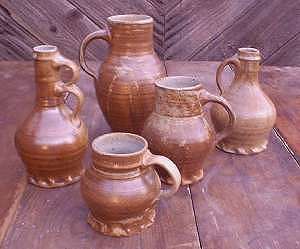
What we had settled on him producing is Raeren vessels, primarily of biconic mug form (initially). This is distiguishable from the perhaps more famous Seiburg ware by having an incidental slip of oxide applied (rather haphazerdly in the surviving originals), and an incidental salt glaze occuring apparently from the vessels being washed in mineral rich water prior to fireing.
These vessels (both Sieburg and Raeren) were imported into the low countries in the thousands, from the 1450's until this form ceased production sometime in the 1560's. The mugs themselves were often then fitted with pewter lids, and then distributed through France, the Low Countries, and England (Raeren appearing in the Archaological record in England by the mid 1470's - Sieburg appearing decades earlier).
This form becomes so common, that by the year 1500, it appears in the archaeological record even in remote villiages in the hinterland of England. It'd widespread distribution, and it's superior quality has been attributed by some scholars to have contributed to the downfall of the native redware industry in England, and detrimentaly impacting local pottery manufacture throughout Northern Europe, either driving the trade out, or forcing local potters to concentrate on more decorative wares.
Anyhow, for a Northern European on the Continent, from the 1460's to the 1560's, this is the stuff that would be in common use in a middle class setting. Brughels paintings show this stuff all over (check out the baskets of mugs and jugs in his "Peasant Wedding". From the 1470's on, it would be found with increasing frequency in England as well.
Anyhow, now it can be gotten through Jeff Brown - here is a link to the Medieval pottery web-page. It won't be up and running completely untill later this week, but I thought I would post this as a source. http://www.jeffbrownpottery.com/medieval.html
Jeff is a very nice fellow, quick to turn an order around. He also listend with seemingly endless patience to me as we went over test throws, with me telling him he needed to keep the throw lines on the bodies, leave the thunb pinches on the bottoms prominent, etc. And it is wood fired stoneware, which is a nice touch.
I will be providing him with more material for different kinds of stoneware vessels, and a costrel as well, so the line should grow.
--------------------
Bob R.


 UBBFriend: Email this page to someone!
 posted 11-24-2001 05:29 PM


