|
Author
|
Topic: Ladies Clothing: Thoughts
|
Fire Stryker
Admin & Advocatus Diaboli
Member # 2
|
 posted 12-17-2004 09:19 AM
    
Clothing aficionados, I was looking at this image from MS9243, f.72 (Bibliotheque Royale -Brussels). The item that I am looking at is the woman's second layer. 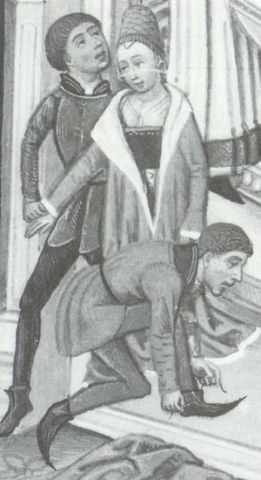 I am looking for thoughts or ideas regarding the construction of this second layer. Is it a sleeveless dress that has one pattern cloth on top and a borcade on the bottom? Have you seen other examples of images that show the under dress of a 1460s - 1480s ladies dress? Jenn -------------------- ad finem fidelis
Registered: May 2000 | IP: Logged
|
|
Charlotte
Member
Member # 620
|
 posted 12-17-2004 07:49 PM
What a great picture! Very interesting, I wonder what the white part is. I've always assumed that the second layer would be rather plain, with perhaps a fancier fabric pinned on as a panel, but this looks as if it's a dress with fancier fabric, and a plain panel pinned on (or something entirely different).Unfortunately, I don't know of much that is *specifically* depicted as a second layer from the time period. The only one I can think of are the ladies standing on a boat from King Rene's Book of Love. Unfortunately, I don't have a copy of the illustrations. The only one I could find online was this:  From: http://www.guice.org/bklvf-55.html I *think* this is the one that shows the panel pinned onto the front, but it's much darker than I remember seeing it before. If anybody else has a better version of what I'm talking about, I'd love to see it. I've been looking for it for a little while. Cheers,
Charlotte
Registered: Jun 2004 | IP: Logged
|
|
|
|
chef de chambre
Admin & Advocatus Diaboli
Member # 4
|
posted 12-18-2004 11:10 AM
Hi All,Yep, in that famous copy of "the Love Smitten heart", all the scenes that take place indoors at dusk, or night time scenes are intentionally painted darker, which I think is very, very cool - the quality of painting, especially for being miniatures really presages renaissance art. -------------------- Bob R.
Registered: May 2000 | IP: Logged
|
|
|
|
Lyndsey Brown
Member
Member # 669
|
posted 01-21-2005 01:44 PM
Jenn...this is a great picture. Thank you for posting it. I am extremely interested in creating a dress with sleeves pinned on in this manner and had planned to ask questions at some point. Thanks for the opener.
Does anyone have an idea as to your early one can date this style? Do you cut and insert the sleeves on the main dress the smae as if they were full length, just make them much shorter? Would you wear the front panel pinned on for decoration or to add an illusion of a layer when an overdress is added?Thank you, Lyndsey -------------------- Lyndsey
Registered: Oct 2004 | IP: Logged
|
|
Charlotte
Member
Member # 620
|
posted 01-25-2005 09:53 AM
quote:
Originally posted by Lyndsey Brown:
Does anyone have an idea as to your early one can date this style? Do you cut and insert the sleeves on the main dress the smae as if they were full length, just make them much shorter? Would you wear the front panel pinned on for decoration or to add an illusion of a layer when an overdress is added?Thank you, Lyndsey
Lyndsey: First of all, welcome! Secondly, it's tough to put an exact date on this style (for me, at least). The basic style seems to exist almost throughout the 15th century. Layering was certainly the norm for ages before that. Take a look at the Web Gallery of Art and *search* on Flemish and French (and German, and others I'm sure I'm missing) art for the 15th century. Unfortunately, there's little English to go on, and virtually nothing in that catalogue. Van der Weyden was active for quite a bit of time, and can give you a good idea of how fashion changed. Basically, in the early 15th century you had very voluminous gowns, profusely pleated, with wide sleeves and a narrow neck opening. As time went on, the sleeves tightened up, the neckline widened, and the pleating disappeared until you have a typical 1460s-70s gown, with a wide v neck, little or no pleating at the waist, a fitted form, and fitted sleeves. Between the 70s and 80s, the fashion again subtly changed to a more scooped neckline. Off the top of my head, I don't know the earliest that the pin on sleeves were used. The earliest I can say for sure is the VdW Deposition from the Cross, c. 1435. There may be earlier examples. From my own experience, once the outer gown sleeve grows tighter, it's more comfortable, and possible without noticing, to not wear the pinned on sleeves. I have mine on in the above, because I was freezing that day, and every little bit helped under my gown (even though the gown itself was fur-lined...). For the underdress, I used a basic short sleeve. Yes, you can just cut down a long sleeve pattern that works for you. Cut it a little long, so you can fiddle with the angle that the bottom edge sits at your arm. In some of the pictures with the sleeve pinned on, it looks like the undersleeve is quite short. I'd have a hard time saying that the front panel is the "illusion" of a layer, because it should be pinned on over the undergown, or your supportive layer. I think of the panel as something more decorative, to smooth the line out. Often, the fitted dress underneath is laced up the front, which wouldn't look smooth underneath the v-necked gown. Granted, if you use a more expensive fabric for the panel, you are giving the illusion of a more expensive underdress. Here is a picture of Jeff and I in our gowns earlier this month. I'm wearing my gown over the ensemble that I have on in the photo above. The dress is a basic 1470s style, and the hood was based on a 1474 portrait. 
Registered: Jun 2004 | IP: Logged
|
|
Fire Stryker
Admin & Advocatus Diaboli
Member # 2
|
posted 01-25-2005 10:13 AM
In the Brussels manuscript, I do not believe that the front is pinned on. I believe that the pins are specifically to hold the thin layer of modesty linen/silk.I cannot find the image from "The Love Smitten Heart" that shows that the front panel is pinned. If you have a better one or know where to track it down, Char, I'd appreciate it.  The earliest I have seen the pin on sleeves is early 15th c. But I haven't examined much art work before the 1400s. -------------------- ad finem fidelis
Registered: May 2000 | IP: Logged
|
|
|
|
Charlotte
Member
Member # 620
|
posted 01-25-2005 11:59 AM
quote:
Originally posted by Fire Stryker:
In the Brussels manuscript, I do not believe that the front is pinned on. I believe that the pins are specifically to hold the thin layer of modesty linen/silk.
I agree that there could be something different going on there. quote:
I cannot find the image from "The Love Smitten Heart" that shows that the front panel is pinned. If you have a better one or know where to track it down, Char, I'd appreciate it.
I wish I knew where to find one. This page has a link to it, and the text:
"The dark colors reflect the fact that this is a night scene. The linked image is a detail from the larger work, showing what may be a kirtle with a pinned on piece. This piece would be the visible portion at the neckline of the Burgundian gowns, above." is the analysis I've seen of it. 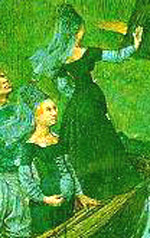
...is the closeup it links to, but again, is very unclear. I've seen a better version that looks obviously like a dark placket or panel on the front, but darned if I can find it again... I'll keep looking.
[/B][/QUOTE] I agree, this one (blurry) picture is scant evidence. The placket works for me, because there's little chance that I could get the right sillhouette in a side laced gown (with my figure), most of the kirtles that we see have a more rounded neckline and the placket can be dead straight across, and frankly, I haven't seen any better arguments until the above picture.
Registered: Jun 2004 | IP: Logged
|
|
Charlotte
Member
Member # 620
|
posted 01-25-2005 12:08 PM
quote:
Originally posted by Martin:
Hi,
first of all a very nice picture Charlotte!
Would get the envy of any Company of Sainte George member! The problem with pictures pre 1400 is that they tend to be less acurate, if you look at the Decamaron from Boccacio which is late 14th century, you will see the style is quiet differant, and there is no evidence of pinned on sleeves. Maybe south of the Alps that might already be in fashion but pretty sure not north of them until after the first quarter of the 15th century. Very nice examples you will find on paintings from Roger van den Weiden.
Thanks for the complement, Martin! I'm originally a 14th century wonk, turned 15th c. to play LH around here. In all of my searchings, I've never noticed the pin-on sleeve prior to 1400, or up to about 1410. My assumption to when they originated was sometime at or after the turn of the century, when the outer-most dress became large and voluminous, and sometimes had large, drippy and open sleeves. Pre-1400, the overdress was usually fairly fitted in the upper arm, and I don't think a pinned on sleeve would have been very comfortable. But exactly when that first person realized that they could put a more expensive fabric just on their arms eludes me to any time more specific than 1400-1435. (with 1400 being about the debut of the huge sleeves, and 1435 being the Deposition from the Cross). One thing I've noticed, is that the later it gets, the more often the pinned on sleeve is just on the Magdalene. My suspicion is that while the outer sleeves got tighter (1480s), the pin on sleeve fell out of use as much, but the artists continued to paint the Magdalene in the same array. Just a thought...
Registered: Jun 2004 | IP: Logged
|
|
Martin
Member
Member # 603
|
posted 01-26-2005 10:53 AM
Hi Charlotte,
yes I agree with you, several artists kept on painting in the old style, thinking of the "Schedels Weltchronik" which is I beleave 1520´s, you find masses of pictures of long pointed shoes, tight hose, V-shaped burgundian style jackets. As to those pinned on sleeves,
I would say that was a cheap way of making out of one dress a dozen or more variations. And come to think of it, when it is about fashion nothing really has changed has it? People have always wanted something special, and not always the same.
I would go so far to say people never change only the circumstances, have been looking at roman grafitis, and what they wrote except that it is in latan, there is no differnace to modern grafitis.-------------------- Verpa es, qui istuc leges. Non es fidenter scripto!
Registered: May 2004 | IP: Logged
|
|
Gwen
Member
Member # 126
|
posted 01-26-2005 11:15 AM
if you look at the Decamaron from Boccacio which is late 14th century,The popular edition of the Decameron many of us use (Biblioteque de l'Arsenal, Paris, Ms. 5070) was painted in 1430-1440 to illustrate the French translation of the Decameron which was completed in 1414. The illustrated translation was done for Phillip the Good of Burgundy. The ilustrations were done by two unknown Flemish artists. Some of the men's clothing is very similar to those worn by Phillip and Charles in the "Chronique de Hainault" and other contemporary works, so it's probably fairly safe to use these images as a guide to the styles of the period. Gwen Gwen
Registered: Feb 2001 | IP: Logged
|
|
|
|
|
|
|
|
|
|
|
|
Charlotte
Member
Member # 620
|
posted 03-09-2005 10:52 PM
Back to this image: *slaps forehead* I was just looking at another copy of it, that's not much brighter, but realized I was looking at it wrong. So, the woman who is facing us and to the right, you *can* actually tell that she has some sort of a "placket", probably. I was misinterpreting the lighter area under her bust. Across her bust, it is solid dark. Some sort of solid fabric. Just below that, she looks like she's wearing a lace up dress that's been left quite wide open. The lighter blue area looks like a chemise in the dark, and you can see lacing across it in probably a wide spiral. I'm not sure what would account for dark across the bust, worn over a half open dress, if it's not a placket of some sort. Does the image make more sense now? Then again, maybe I was the only one looking at it wrong. 
Registered: Jun 2004 | IP: Logged
|
|
|



 UBBFriend: Email this page to someone!


