OK, furniture is as follows- Beds, take-down type, carved headposts with dragon ornament, planks about 30mm thick and 100mm wide.
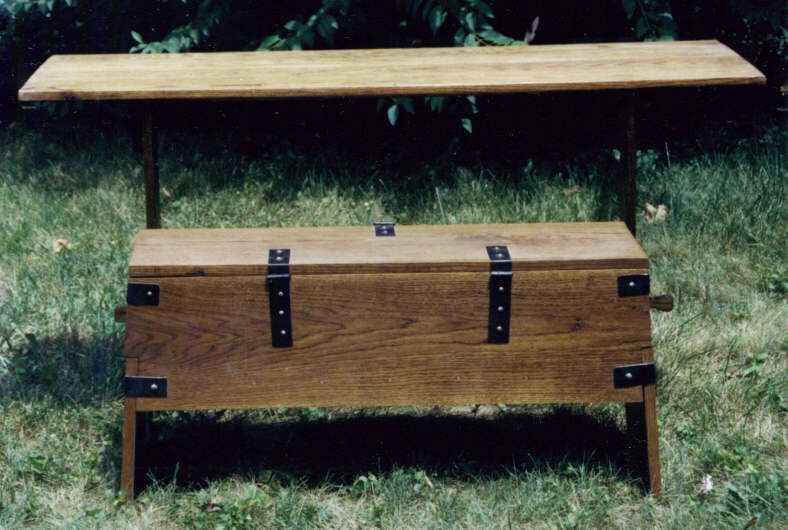
- Chests, about 1 m long, 30cm wide, 30cm high, standing on 20cm "legs" (actually just the end planks continuing below the floor of the chest) tops plentifully studded with large rivet heads.
- Chair, square box seat with plank back (extension of back planks of box seat), rather crude-looking actually, planks thinner than chests or beds.
I'm also copying in the e-mail I did to a bunch of my friends who are viking era re-enactors - it summarises most of the stuff, and I'm too lazy to write it all out again from scratch.
Ask for more details if you have specific questions.
"Hiya everybody;
Took advantage of being stuck in Scandinavia to hit the viking ship museum, near Oslo, and figured enough of you lot would be interested by the info from it to justify sending round a general mail rather than talking to people individually. Note that there is another, completely different, viking ship museum, in Roskilde, which has five ships deliberately sunk to block one of the channels of copenhagen harbour about 1000, as well as this one.
The Oslo museum's got three viking ships, all used for boat burials and found ashore under burial mounds. The two famous ones - the Oseberg and Gokstad ships - were in very waterlogged condition, and preserved almost complete, while the third - the Tune ship, the one that appears in almost everybody's memory as "....and the other one" - is nothing like as well preseved, essentially rotted down to its lower hull. The museum also has a few finds from a fourth ship burial, at Borre - the ship here had completely decomposed, leaving only the nails, but some metal artefacts were recovered.
All three ships had seen use before burial. The Oseberg ship (c AD 830) is the one you see on all the pictures - highly carved and decorated, and complete with the dragon-head prow beloved of artists. It's actually not that heavily built, and really isn't likely to be capable of serious voyaging - think equivalent of a ceremonial Royal Barge or similar, only really intended for coastal work in good weather.
The Gokstad ship (c AD 950) is a lot plainer, but also a lot more practical - no carving, stronger keel, higher freeboard, good strong mast-step etc - some loon actually sailed an exact copy of the thing across the atlantic without too much trouble. We're looking at the smaller, lighter end of the longship market here, a real sea-going vessel. In so far as we can tell, the Tune ship is pretty similar to the Gokstad ship. Rowing crews are probably betwen 30 (Tune) and 34 (Gokstad), plus non-rowers such as the helmsman.
All three burial mounds were robbed in antiquity, and don't contain any weapons, jewelry or other lootables, but do still contain - particularly the Oseberg ship - large amounts of well-preserved wooden artefacts, and even textiles.
Nothing useful comes from Tune (everything's too decayed) but the Gokstad burial includes three small boats, a sled, tents, a couple of beds, a rucksack (oval top and bottom formed from planks, bearing marks of what appears to be a basket-work body)and a bridle (modern caveson design, decorated with plates over most of headband, cheekpieces and noseband). There's also another bridle (Y-shape noseband style, with similar decorative plates) and a frankish glass beaker which must have been nearly a century old when it went into the ground from Borre.
Star of the show, though, is the Oseberg ship, which basically seems to contain the entire travelling equipment of a Viking queen's household - a wagon, three sleighs, tents, beds, chairs, cooking and eating gear, weaving equipment, tools and personal clothing, plus the skeletons of at least 10 horses, and possibly a maid - there are two female bodies, and whether the worse-dressed one just happened to die at a convenient time to be buried with her mistress, or got sacrificed along with the horses isn't clear.
The four-wheeled Oseberg wagon is intended to be pulled by two horses, and is very highly decorated - pretty much every inch of bodywork is carved in relief - but wouldn't actually have been much damn use as a vehicle - it's ridiculously small for a two-horse wagon, and the front axle is fixed rather than able to pivot, which'd give it a turning circle about that of the QE2. The museum have therefore decided it's a "Ceremonial" vehicle, which is archaeologist-speak for "it's odd, and we can't immediately explain it."
The sleighs are also highly decorated, but a lot more practical. I'm not going to bother with any more on them, as I doubt even anybody on this list is likely to want to build one!. The A-frame style tent poles and the corner posts of the beds are all topped with animal-head designs, quite showy if you like that sort of thing. The chair (the only viking-era chair known, if you believe the museum!) is a simple box, with flat board back and basketry seat, originally highly painted. Chests are smaller than I'd envisaged, a little bigger than the wooden cases for 105mm ammo, with a board "foot" at each end, and heavily reinforced by studding and banding. Some really nice buckets and tubs, too.....and if you don't think that a bucket is anything to label "really nice", I'll show you the photo. Think Gundestrup cauldron's wooden baby brother
I took quite extensive notes on the asorted cooking and eating gear, as that's the sort of stuff we might want to reproduce, but it's easier to discuss it with those interested rather than go through it here. It also inclued a bunch of spades, Bayeux tapestry step-on-one-side pattern as well as ones almost like short oars, with two sloping shoulders.
Textiles surviving included a smallish tapestry, pieces of wool big enough to preserve patterns (a dire black-and-white tartanish pattern), tablet weaving, and several pieces of patterned silk used as edgings and trim, plus two pairs of ankle boots, both in good repair (George, photos are in the post!).
Finally, and most usefully, there's a viking-era schooling whip (same weight and balance as a modern one, to judge by looking at it, with an animal-head top), plus what is as far as I know the only viking-era saddle (OK, so I'm obsessed, but it is kind of a useful thing to have an example of!). High pommel, but almost no cantle, unless it was made of leaher and has rotted away, seat and tree largely made of wood (no, I don't even want to think about it!), but presumably originally covered and joined by leather. There were apparently ten horse skeletons in the find, too, but the museum barely mentions them, and doesn't give any indication of size - one of its odd omissions, along ith the fact that there isn't a single on of the 64 sheilds found along the side of the Gokstad ship on display, which is kind of a pity, as I do't think we have that many actual examples of viking shilds from any other find.
Photos and guidebook to follow on my return
Neil"



 UBBFriend: Email this page to someone!
 posted 07-04-2002 06:15 AM


 posted 10-07-2002 01:27 PM