|
Author
|
Topic: Complex of armour for Dijon militia (1400-1430)
|
|
|
Bertus
Member
Member # 308
|
 posted 01-23-2006 01:08 PM
   
I don't want to sound rude but shouldn't you have a look around yourself first, before asking people to send you half their database of pics?
It isn't that hard to lurk about on some armour forums such as the Armour Archive and pick up some titles of relevant books that you can borrow from a library.Next to that, welcome aboard!  -------------------- Bertus Brokamp
Registered: Apr 2002 | IP: Logged
|
|
T1R1ON
New Member
Member # 969
|
posted 01-23-2006 04:20 PM
Dear sir!I'll follow your advise and i'm thankfull for you to be so patient. The brigandine i'm using today is considered to be of a "Inssbruck type". I've seen a lot museum pictures of "Chalkis" and "Wisbi" type brigandines, and i've studied the photos of Schloss Amras collection but there's only full-plate armour. Does the "Inssbruck" type brig exists or it's a tale?  That's that brig and practically all my battle complex without the helmet.
Registered: Jan 2006 | IP: Logged
|
|
chef de chambre
Admin & Advocatus Diaboli
Member # 4
|
posted 01-23-2006 05:51 PM

What is an "Innsbruck type" brigandine? I have never heard of the term, and wonder where you got it from. Most extant brigandines are of Italian and Spanish origin, or have associations with France or England. They widely appear in art from Italy and Spain, in a swathe through Western Europe, up into the Low Countries, but they are less frequently seen in German and Central European art.
Regarding the Wisby and Chalcis (Negroponte) finds - the first exaple are coats of plates, and are substantially different in form from brigandines. The Chalcis finds are generally reffered to as 'corrizones', save for an extremely ugly vest made up of nearly identical square plates, without any distinctive form (now in the Metropolitan Museum of Art, ex Bashford Deane collection). Corrizones are generally considered to be early forms of brigandines.
Coat of plates are quite distinctive - they are not tailored as brigandines, essentially being armoured tubes, and seemingly descended from 13th century reenforced surcoats or armoured girdles - they fasten most commonly up the back, or at one side, wheras berigandines and corrizones (of 15th cenury date) open up the front centerline - albeit with an overlap of plates. What you seem to be wearing I would say is a mid 15th century form, perhaps more common 20 years post the era you are portraying. ONe error I see in the reconstruction is that at this time, the brigandine nails holding the plates to the foundation are almost invariably seen in clusters of three nails, making a triangular form, and the nails are usually smaller - it is not until the late 15th century, and the advent of more rows of smaller plates in the garments that one finds rows of single nails holding the plates. Coats of plates, on the other hand usually have a single row of large headed nails or rivets holding the plates to the foundation, but these do not close up the front - the front is a soloid series of plates, and usually the siders extend round in a girdle of plates, fastening up the back. The form dissapears by the late 14th century, cusp of the 15th century, so far as we know. It was replaced by the handier brigandines, or the more solid white armours developed at the time. -------------------- Bob R.
Registered: May 2000 | IP: Logged
|
|
T1R1ON
New Member
Member # 969
|
posted 01-23-2006 06:33 PM
I almostly agree with you about the error in the amount of nails (there were always 3). It seems that our armourer has "invented" that Innsbruck type, cause he couldnt provide any source too. Thank you for avoiding future errors *)Chalcis. As i know the covering for the "corrizones" found was in extremely bad condition an not all the pieces of that armour were found. 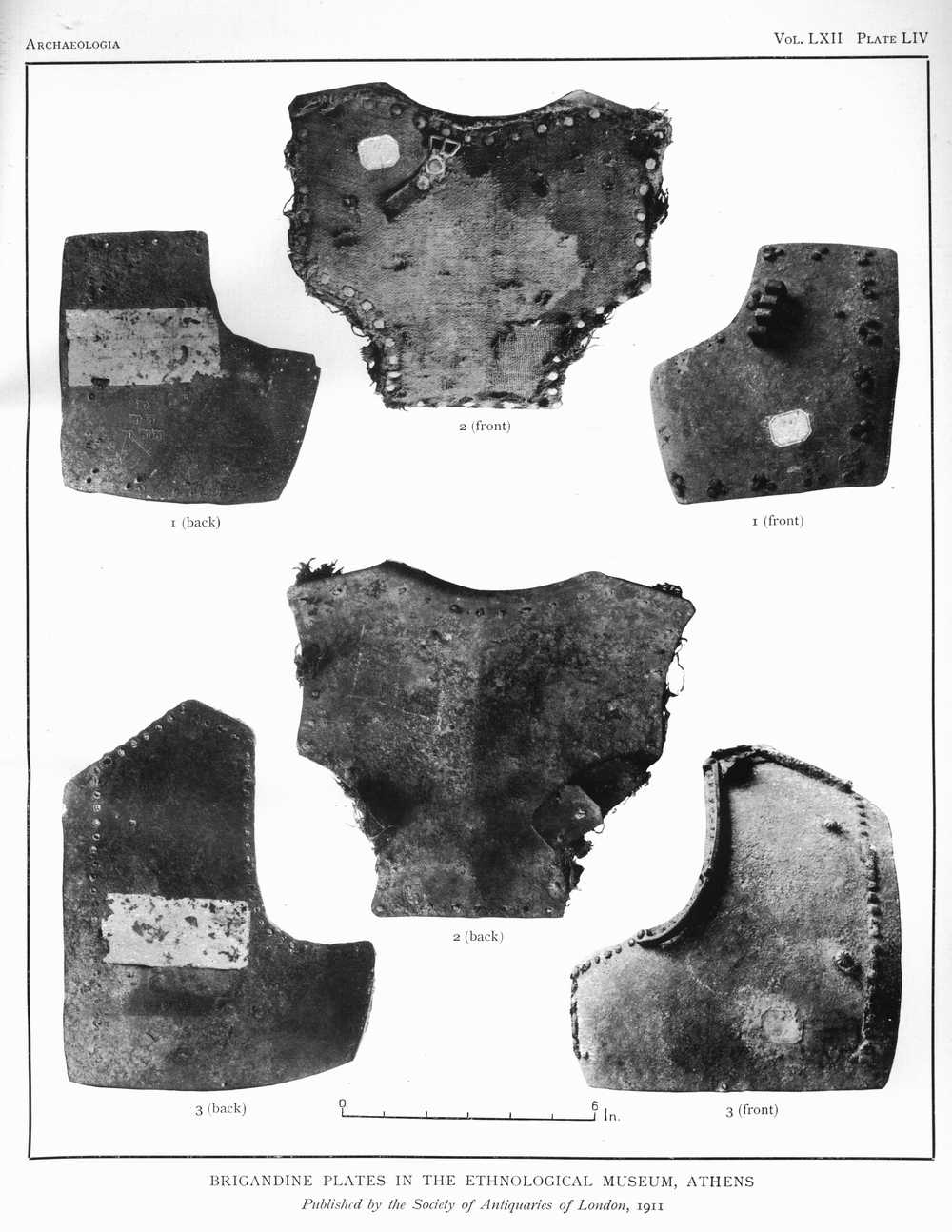 I have heard about at least 2 different reconstructions of that model. First - from Metropolitan NY, and the second made by Klim Zhukow, the images you could see below: could this type of corrazina be in use in the mentioned period Dijon militia halberdier?      
Registered: Jan 2006 | IP: Logged
|
|
wulfenganck
New Member
Member # 966
|
posted 02-02-2006 06:30 AM
Hello,
you can find an interesting article about the reconstruction of a brigandine here:http://www.company-elefant.com/deutsch/bibliothek/_notes/brigantine.pdf
It's in german, but it has some good pictures, both of the original - which seems to be the one in the metropolitan museum in New York you've mentioned - and the reconstruction.The site in general should be quite interesting for you, since the Gesellschaft des Elefanten (Company of the elefant) covers the period 1405 - 1430. Although they cover Austria (Tirol), therefore there might be some major differences to Burgundy in clothing style, armour etc. Greetings, Wolfgang
Registered: Jan 2006 | IP: Logged
|
|
|



 UBBFriend: Email this page to someone!
 posted 01-23-2006 10:33 AM


